
In public debate, critics of leftism take malicious delight in pointing out its contradictions. They note, for example, that leftism claims to defend the environment on the one hand, while ignoring the ecological disaster caused by fast fashion or mass tourism on the other. They also remind us that leftism treats gender equality as a first principle, while condemning exclusively male safe spaces but, curiously, not their female equivalents. Contradictions of this kind are so numerous that attempting to list them all here would be futile.
Each of these inconsistencies is then paraded like a trophy: a kind of gotcha supposedly capable, all by itself, of invalidating the opposing camp’s ideology. To its critics, the inconsistent nature of leftism proves that it ultimately does not deserve to be taken seriously. And yet, this charge of hypocrisy does not trouble its supporters in the slightest. Leftism mobilizes, legislates, and continues to shape society as though nothing were amiss.
This raises a question: can leftism rationalize itself without betraying itself? The purpose of this article is to show that it cannot. If, as the LFE claims, leftism is the political expression of female preferences, then the rational application of any grand principle will inexorably end up conflicting with those female preferences. Even when that grand principle was itself deduced from the LFE, that is, from female preferences themselves.
The defense of biodiversity, an obviously female interest, is one such example. From a strictly rational and ecological standpoint, that is, setting our emotional responses aside, it is in fact insects and other invertebrates that play the most fundamental role in sustaining ecosystems. By comparison, mammals occupy a far more secondary place within them. If leftism applied its defense of biodiversity consistently, it should therefore protect insects first and foremost.
Yet women do not generally like insects. Whether spiders, cockroaches, or other arthropods, these small creatures that crawl, sting, or buzz trigger a visceral reaction of fear or disgust in a large proportion of women. Conversely, cute mammals such as the fox, hedgehog, or squirrel, the seal, or the dolphin, as well as small, colorful, melodious birds, are particularly prized by women.
If the LFE is correct, it is therefore these popular species, rather than those that are ecologically useful or genuinely threatened, that leftism should protect first. Leftist choices would ultimately be driven not by reason, but by female preferences themselves. Is that in fact the case?
That, at any rate, is what the European LIFE programme appears to show: projects devoted to protecting vertebrates receive up to six times more funding than those devoted to invertebrates. Once this gap is adjusted for the number of species concerned, the disproportion becomes simply enormous, amounting to several hundredfold.
Even other principles to which leftism lays claim, such as the precautionary principle or the protection of public health, do not in fact stand a chance against female preferences. The example of neonicotinoids is revealing in this respect. This class of insecticides was initially introduced in the 1990s as a less toxic alternative to older products, as well as a means of promoting so-called precision agriculture. Neonicotinoids would thereby have reduced health risks for mammals and farmers, without compromising agricultural production. These substances do, however, have one major flaw: they kill a social and matriarchal insect particularly prized by women, namely, the honey bee.
It was therefore by invoking the risks posed to pollinating species, including honey bees, that the European Union decided to severely restrict the use of neonicotinoids. The argument appears consistent, except that the vast majority of pollinating species are wild. Solitary bees, which are less prized by women, thus contribute far more to pollination than honey bees do. When it comes to protecting these solitary bees, however, leftism becomes much more discreet. Worse still, it even contributes to their decline by constantly favoring the honey bee: beehives installed on the rooftops of large cities, for example, increase competition between species and reduce populations of wild pollinators. Is it therefore biodiversity that motivates these leftist choices or, rather, the female attraction to the honey bee?
At times, the grand principles in which leftism takes pride nevertheless appear to be applied rationally, that is, as strictly as leftism claims. This is notably the case with opposition to the death penalty, which the European Union in fact imposes as a necessary condition for membership. In France, its prohibition was even enshrined in the Constitution in 2007, which says something. Yet according to the LFE, capital punishment was abolished above all because it conflicts with a strong female preference, not solely out of humanitarian concern.
Indeed, every opinion survey agrees on one point: men support the death penalty far more than women do. Even in the United States, where it remains in force in several states, two-thirds of women prefer life imprisonment without parole, compared with only slightly more than half of men. Moreover, opposition to capital punishment perfectly illustrates what a strongly leftist trait looks like. Whether in the United States, France, the United Kingdom, or Canada, rejection of the death penalty is systematically stronger among left-wing men than among right-wing women.
And yet this female aversion to the death penalty disappears in one specific case: when the victim is a child. A YouGov survey conducted in seven European countries shows, for example, that support for capital punishment soars as soon as the crime in question is the murder of a minor. In the case of child sexual abuse, the gender gap is outright reversed, according to an American study: women suddenly become more punitive than men. If the LFE is correct, modern societies could consequently reintroduce the death penalty, or at the very least life sentences, but only for crimes committed against children. In the meantime, they could settle for making the release of child sex offenders conditional upon chemical castration, even though such a measure conflicts with another principle to which leftism lays claim: bodily autonomy.
If leftism is the political expression of female preferences, a similarly context-sensitive approach should then apply to mandatory minimum sentences, otherwise known as sentencing floors. Yet here again, left-wing movements prefer in practice to invoke grand principles: human rights, rehabilitative rather than punitive justice, individualized sentencing, judicial discretion... Opinion surveys further show that this context-dependent approach to justice is more strongly supported by women than by men, in accordance with the LFE. It is precisely when these leftist principles are applied rationally and uniformly, that is, irrespective of context, that they ultimately come into conflict with female preferences.
In France, for example, the 2007 Dati Act introduced mandatory minimum sentences for all repeat offenders, regardless of the crime they had committed. Then, in the name of a consistent conception of individualized sentencing, these mandatory minimums were ultimately abolished by François Hollande’s left-wing government in 2014, through the Taubira Act. Had the French left remained faithful to the context-sensitive nature of female preferences, however, it would not have abolished all mandatory minimum sentences. Instead, it would have removed those applying to theft, destruction of property, drug offences, urban violence, or ordinary homicides, while preserving, or even strengthening, those applying to rape, violence against minors, domestic violence, and femicide. In other words, minimum sentences should apply primarily to crimes that disproportionately affect women and children, but not to those that disproportionately affect men. If the LFE is correct, a correction in this direction is therefore to be expected.
Such a correction is in fact already underway in Canada. In 2022, Bill C-5 abolished mandatory minimum sentences, notably for drug- and firearm-related offences. A few years later, as expected, Canada adopted legislation moving in the opposite direction through the Protecting Victims Act, or Bill C-16. The long title of the legislation is already enough to grasp its scope: “child protection, gender-based violence, court delays and other measures.” Bill C-16 thus reintroduces mandatory minimum sentences where the LFE predicts them, that is, for crimes targeting women and children. Canada is therefore undergoing a genuine reversal, in apparent contradiction with the grand principles in which leftism ordinarily takes pride.
How do left-wing movements justify this reversal? In addition to protecting children, by claiming that they seek to combat reoffending. Yet the statistics are clear: almost everywhere, perpetrators of sexual offences return less often before the courts than perpetrators of ordinary violence, theft, or property offences.
In Canada, in particular, five years after their release, 25.4% of sexual offenders and 23.6% of homicide offenders had been convicted of a new offence, compared with 54.2% of assault offenders and 63.6% of property offenders. Yet it is sex offenders, or anyone who targets women and children, that leftism treats as guilty for life: no individualized treatment is therefore owed to them. Not even once they have served their sentences, moreover, as illustrated by the sex offender registries found in various Western countries. Measures which, incidentally, have no equivalent for non-sexual violence primarily affecting other men.
Rather than proving the inconsistent nature of leftism, might these laws not simply be seeking to protect the most vulnerable? That is difficult to believe in light of the following fact. In Canada, femicide is now classified as first-degree murder and, as such, carries a mandatory minimum sentence of twenty-five years in prison. By contrast, infanticide committed by a mother who kills her newborn child immediately after giving birth carries no mandatory minimum term of imprisonment. Worse still, this crime is punishable by a maximum sentence of five years, five times less than the mandatory minimum sentence imposed for femicide.
This curious asymmetry can also be found in Sweden, where femicide carries a mandatory minimum sentence of ten years in prison, compared with a maximum sentence of six years for maternal infanticide. Even Italy is gradually falling into line with this logic, now punishing femicide by at least twenty-four years in prison, but maternal infanticide by no more than twelve. According to leftism, then, the murder of a newborn child by its mother would be far less serious than the murder of a woman by her partner. The monopoly of pregnancy thus prevails even over the mandatory minimum sentences imposed for crimes against children.
What should be concluded from these examples? Quite simply that, by disregarding context, the rational application of a grand principle ultimately comes into conflict with female preferences that are just as important. Even when that grand principle was itself deduced from the LFE. The categorical rejection of mandatory minimum sentences, for example, ceases to be leftist as soon as it results in exempting criminals who have assaulted women or children. Except, of course, when the criminal is a mother who has committed infanticide against her newborn child.
To remain aligned with female preferences, leftism is therefore forced to amend its own prescriptions at a level of detail bordering on the absurd. Every female preference neglected thus far calls for a new exception, leading to an accumulation of increasingly meticulous and asymmetric legislation. Ideal leftism thus resembles less a coherent ideology, developed deductively and uniformly, than a disjoint aggregate of ad hoc decisions: a kind of fractal whose level of detail continues to increase as leftization progresses.
Consequently, as the world becomes more leftist, regulations proliferate excessively while growing ever more contradictory. This is the price to be paid for representing female preferences as faithfully as possible. In our modern societies, this normative inflation manifests itself notably in the disproportionate growth of bureaucracy, the multiplication of regulatory bodies, and the continuous increase in the complexity of legal texts. In France alone, the Penal Code grew from 78,946 words in 2003 to 141,264 words in 2025, while the Civil Code expanded from 145,454 to 192,277 words over the same period. Moreover, it is the most leftist codes that have undergone this normative inflation most severely.
More abstractly, the level of leftism of a political expression is not stable under particularization: adding an apparently innocuous detail is sometimes enough to reverse entirely the political orientation of an initially leftist decision. What, then, determines this political orientation? Whether or not it aligns with female preferences. In other words, leftism may be inconsistent at the level of its justifications, but it remains remarkably consistent at the level of the preferences it embodies. The example of butterflies is particularly amusing as an illustration of this instability under particularization.
As a reminder, the rational application of biodiversity conservation would force leftism to defend all insects, including spiders and cockroaches. Yet, for obvious reasons, insects are not generically leftist. Honey bees, ladybirds, and butterflies, however, are particularly prized by women: they are therefore leftist. Indeed, it is for butterflies that the difference in appreciation between men and women is the greatest, both among children and among adults. If leftism is as context-sensitive and dependent upon female preferences as the LFE claims, this female attraction to butterflies should be reflected in conservation policies.
A large-scale European study confirms this. By comparing the butterfly species actually protected by law with those whose protection would be justified on ecological grounds, the researchers identified a striking bias: legislators primarily protect the most beautiful butterflies. Thus, one quarter of the twenty butterfly species judged the most “charismatic” enjoy institutional protection, compared with none of those selected according to strictly scientific criteria. The European Union, for example, generously funds the conservation of the marsh fritillary, a pretty butterfly with mottled wings, even though the species is classified only as “least concern” by the IUCN. Across the Atlantic, it is the highly photogenic monarch that has been elevated into an icon of conservation.
When it comes to protecting moths, by contrast, leftism becomes much more discreet. Yet moths belong to the same biological order as butterflies, are up to nine times more numerous, and perform ecological functions that are just as important. What is their crime? Being brown, hairy, and fluttering around lamps. In short, looking like insects and, consequently, being less appreciated by women.
Such an analysis could, moreover, be pursued indefinitely, precisely because adding an apparently innocuous detail is sometimes enough to reverse a female preference. The level of leftism itself therefore reverses along with it. Species prized by women and perceived as “glamorous,” such as the luna moth or the Spanish moon moth, will thus continue to receive subsidies. As for the others, such as the clothes moth, they should soon find themselves consigned to the dustbin of biodiversity.

In summary, leftist choices are not determined by grand abstract principles, but by a much more down-to-earth criterion: their alignment with female preferences. Yet female preferences cannot be deduced from a system of axioms. They compete with one another, shift in priority depending on the circumstances, and sometimes hinge on seemingly innocuous details. In other words, they are contextual rather than deductive. Yet male preferences are contextual too. Should rightisms not, in turn, be inconsistent as well?
Except that the two sexes do not handle their preferences in the same way. Who, for example, feels the greater need to formalize their tastes into grand principles: men or women? To systematize the world? To turn an intuition into a general rule, then demand that this rule be applied all the way to its most extreme logical consequences? Statistically, men do. None of this, of course, says anything about the respective cognitive abilities of the two sexes. It merely underscores that men and women use reason differently.
Several studies in differential psychology confirm this difference. In particular, men score higher than women in systemizing, that is, the propensity to analyze or construct systems governed by strict rules. Women, by contrast, score higher on empathy, understood as the ability to identify the mental states of others and respond to them appropriately. This contrast extends even to occupational choices: men gravitate more toward careers centered on things, whereas women gravitate more toward people. Female preferences are thus less amenable to rationalization into abstract systems and depend more heavily on the context in which they are expressed.
Under the LFE, this lower female propensity for systemizing translates directly to the societal level: leftism is not a coherent ideology and was never meant to be one in the first place. Believing that merely exposing its contradictions would be enough to discredit it, as though they amounted to a gotcha, is therefore a mistake. Female preferences determine leftist choices, not the grand principles invoked after the fact to justify them. Leftism therefore cannot rationalize itself without betraying itself.
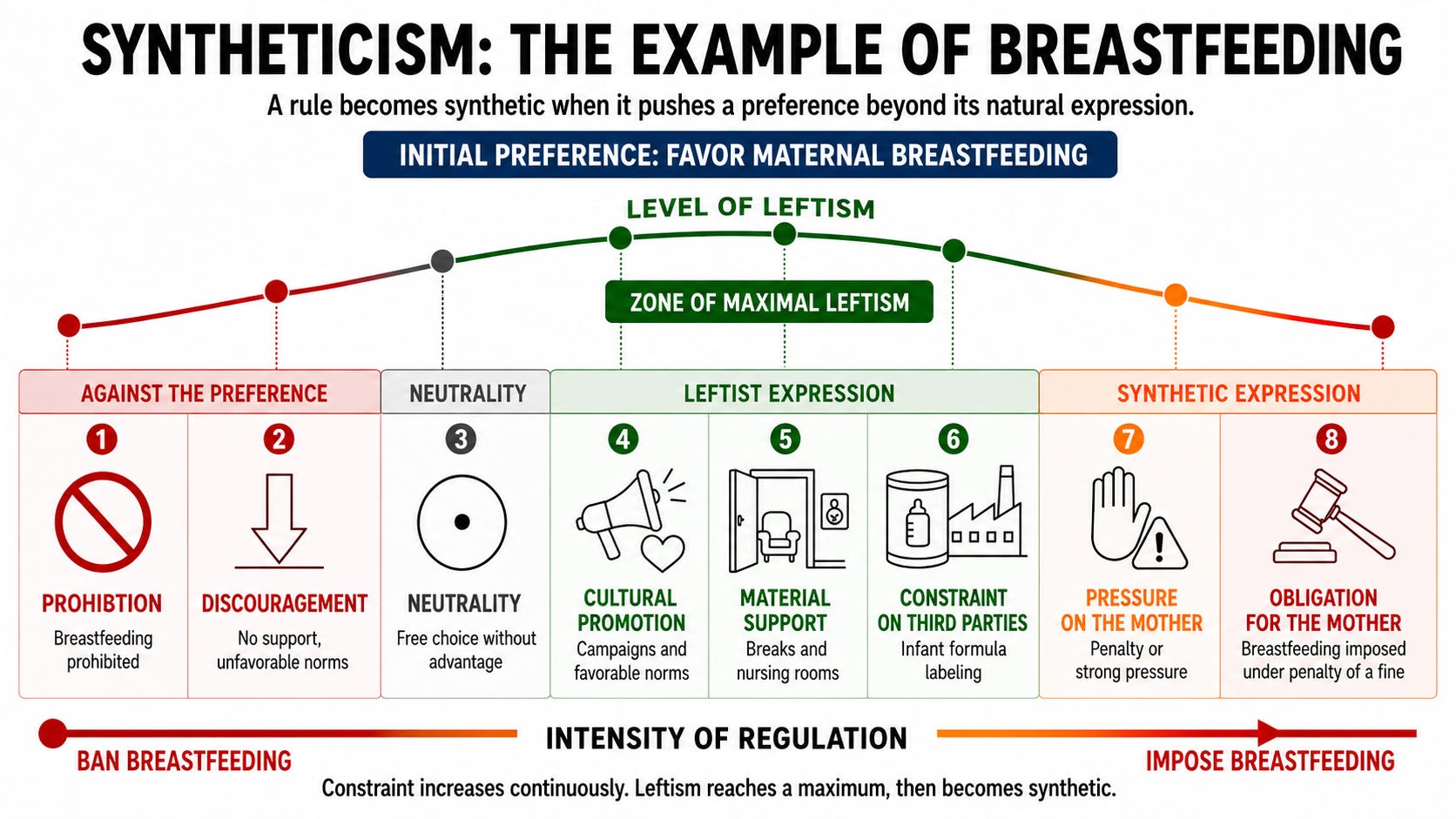
This incoherent nature of leftism gives rise to the concept of synthetic leftism. A political expression is said to be synthetic when it rationalizes a natural female preference or pushes it beyond its natural bounds. Like fully leftist expressions, synthetic expressions can take shape in law, cultural norms, or the marketplace. But because they reflect less faithfully the female preference from which they derive, they do not necessarily maximize the level of leftism. The most leftist political expression is therefore not always the most radical or the most restrictive.
The leftist conception of breastfeeding provides a good example. The most leftist position is not to impose breastfeeding on all mothers, but to promote it both culturally and materially. Requiring a woman to breastfeed her newborn would indeed amount to interfering in her reproductive choices and, consequently, calling her monopoly of pregnancy into question. Such an obligation would push the preference for breastfeeding to excess, to the point of turning it against other, equally important female preferences. It would therefore constitute a synthetic expression, less leftist than merely encouraging breastfeeding.
Nothing, however, prevents leftism from imposing constraints relating to breastfeeding, provided that they do not bear directly on female choice. Leftism thus requires companies to provide dedicated facilities for breastfeeding. European law goes so far as to require manufacturers of infant formula to include on their packaging a statement concerning the superiority of breastfeeding. The constraint therefore does not disappear: it is shifted onto third parties tasked with facilitating female choice.
As a final example, the Right to Roam of the Nordic and Baltic countries likewise illustrates the synthetic nature of rationalized political expressions. This common right of access grants everyone the freedom to enjoy forests, lakes, rivers, and other natural riches, including when they are located on private property. Without completely abolishing private property, the Right to Roam thus considers that nature belongs to no particular individual, but rather to the community as a whole. It is indeed a leftist measure, since it answers two complementary female interests: an attraction to communal sharing and a taste for naturalness. Incidentally, the Right to Roam also allows itself to trespass upon the private property of a typically male place that nevertheless has nothing natural about it: golf courses.
Leftism nevertheless ensures that the communal sharing permitted by the Right to Roam stops exactly where women wish to draw the line: at the intimacy of the private sphere. This common right of access therefore does not include gardens and vegetable gardens adjoining homes, nor the terraces, swimming pools, or children’s play areas of private residential developments. For such an extension, rather than merely making nature accessible to everyone, would allow strangers to intrude into the spaces where women live, rest, or let their children play. Extending the Right to Roam to these spaces would therefore push one female preference to the extreme at the expense of all the others. It would consequently constitute synthetic leftism, that is, a less leftist measure. Better still: a communist measure in a generalized sense.
What should we retain from this? First, as the example of the butterflies showed, that the degree of leftism of a political expression is not stable under particularization. In other words, the addition of an apparently innocuous detail can radically alter its degree of leftism. Second, that the degree of leftism of a political expression does not depend on its radicality, but on the fidelity with which it satisfies a female preference. Radicalizing a measure therefore does not necessarily make it more leftist. By rationalizing a female preference, that is, by requiring it to be applied consistently to every particular case falling under the same general principle, syntheticism precisely denies this instability under particularization. In doing so, it opposes one of the fundamental properties of leftism: its incoherence. Leftism is not a coherent ideology and was never meant to be one.
One should therefore expect synthetic expressions to disappear as leftization progresses. The further leftism advances, the less weight its grand principles should carry in practice. Describing leftism as incoherent is therefore not false; it merely fails to understand that its contradictions do not refute it. Quite the opposite: they indicate that it is, before anything else, the political expression of natural female interests and behaviours.