
On 16 July 2026, the British government announced its intention to ban the sale of energy drinks to anyone under sixteen. As usual, leftism justifies the restriction on public-health grounds: the high caffeine content of these products is said to increase anxiety, disrupt sleep and, ultimately, harm their young consumers’ academic performance.
Yet the government itself acknowledges that no study has so far established a causal link between energy-drink consumption and declining academic performance. Why, then, is leftism still so eager to legislate? According to the LFE, the reason is simple: energy drinks represent a predominantly male preference, one that women largely do not share.
To see why, one need only note that energy drinks are marketed as performance-enhancing products. It is hardly surprising, then, that their advertising primarily targets fans of extreme sports, motorsports, competitive video games and bodybuilding. In short, young men intent on pushing their limits. The statistics readily confirm this: in England, one survey found that 29.3% of boys had consumed at least one can during the previous week, compared with only 18.1% of girls. The same asymmetry appears in France, in the United States and even in Finland. Energy drinks, in other words, clearly belong to a far more masculine than feminine world.
Can we find a female counterpart that leftism would favour? We need not look far: Starbucks lattes, Frappuccinos, ultra-sugary iced coffees and bubble teas all fill that role. According to a study of Quebec adolescents, these fancy coffee drinks are in fact the leading source of caffeine among teenage girls, far ahead of energy drinks.
Under the LFE, these differences in preference translate directly to the societal level: energy drinks are thus rightist, whereas fancy coffee drinks are plainly leftist. A public-health policy dictated by leftism should therefore target the former while showing greater leniency towards the latter. Yet caffeine does not change its chemical nature depending on whether it comes with taurine or pumpkin-spice syrup. From a public-health standpoint, only the dose of caffeine consumed should therefore matter. A consistent application of the precautionary principle would therefore impose the same restrictions on Monster cans and Starbucks cups. Yet here again, it is female preference that seems to dictate the direction taken by modern societies.
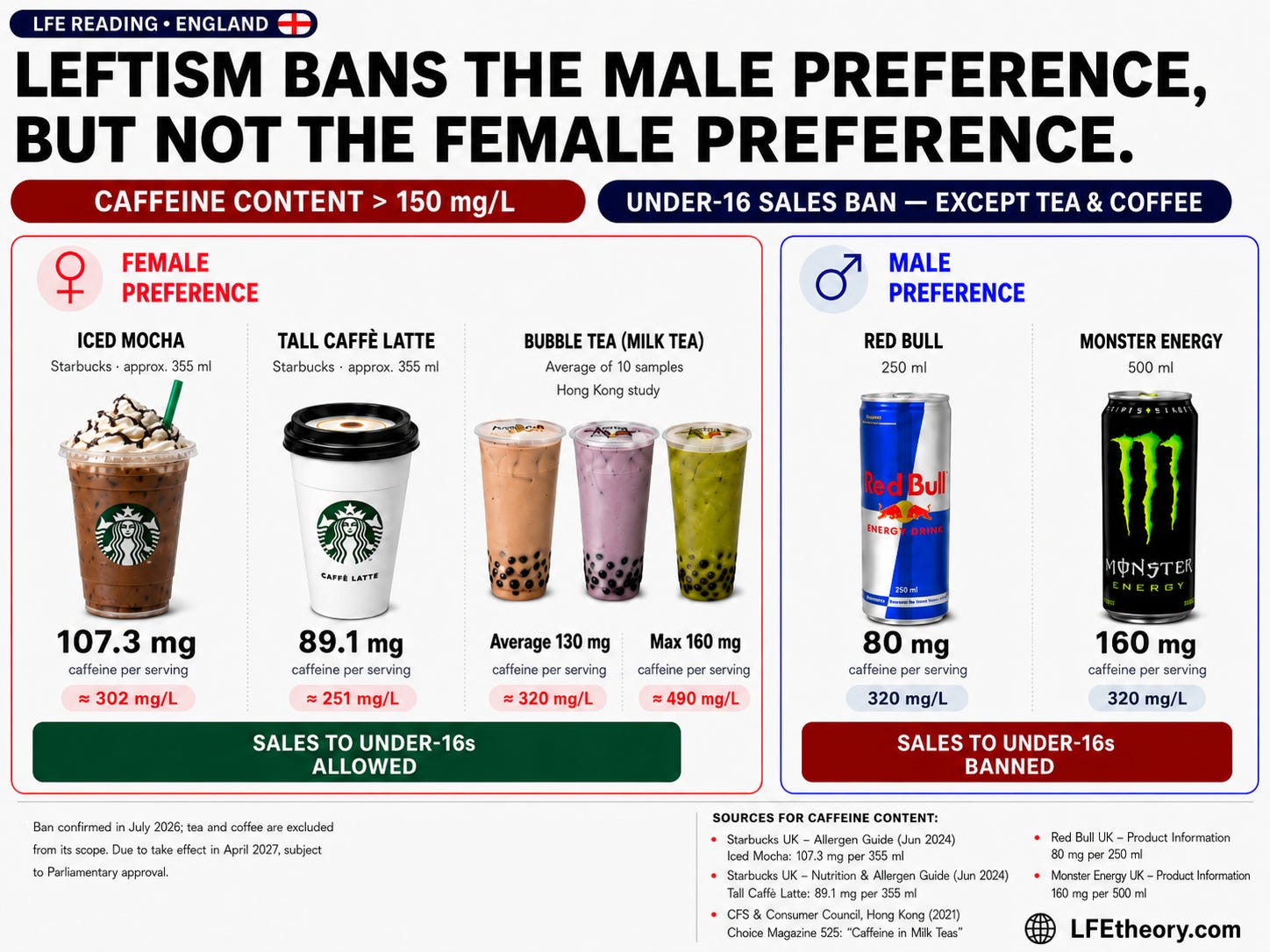
More specifically, the proposed British legislation would ban the sale to under-sixteens of any drink containing more than 150 milligrams of caffeine per litre. With two exceptions, of course: tea and coffee. Once one examines the caffeine concentrations involved, however, these exemptions seem to have no basis at all. A can of Red Bull, for example, contains 80 mg of caffeine per 250 ml, or 320 mg/L. How much caffeine, by comparison, do the drinks favoured by women contain?
A standard Starbucks Tall Caffè Latte contains 89.1 mg of caffeine per roughly 355 ml, or 251 mg/L. A single serving of such a coffee therefore already delivers more caffeine than an entire can of Red Bull. Better still, in the Reserve range, the caffeine content of the same Tall Latte rises to 115.6 mg per serving, bringing its concentration to nearly 326 mg/L. Its concentration is therefore virtually identical to that of Red Bull, but its total dose is considerably higher. Even the Tall Matcha Green Tea Cream Frappuccinos, with a caffeine concentration of 151 mg/L, already exceed the threshold set by the proposed British legislation. As for bubble teas, they contain an average of 130 mg of caffeine per serving, or 320 mg/L: exactly the same concentration as a Red Bull, for a total dose more than 60% higher. Yet leftism still has no intention of banning these highly caffeinated drinks: doing so would mean taking aim at a female preference that has become ubiquitous in popular culture.
This is hardly leftism’s first offence. For more than a decade now, under the guise of fighting obesity and diabetes, Western societies have been taxing sodas and drinks containing added sugars. More than sugar itself, what leftism penalizes here is precisely its added character, that is, its artificiality. The idea, of course, being to satisfy the female preference for naturalness.
So-called “naturally sweetened” fruit juices are thus conveniently exempt from sugar taxes. Even when their sugar content exceeds that of a Coca-Cola. Apple juice, grape juice and cranberry juice are all cases in point. In the United Kingdom, Frappuccinos and bubble teas have likewise long enjoyed this preferential treatment, leftism oblige. France’s tax code, meanwhile, reads like something out of a meme: it explicitly exempts soups, puréed soups, broths... and soy-based drinks from its sugar tax. In short, the very drinks women tend to prefer.
What are we to conclude? That public health and the protection of children do not explain the decisions of liberal societies nearly as well as the LFE does. Even if science and public-health concerns matter, leftist choices appear to be governed above all by the need to accommodate female preferences. Monster and Coke will therefore have to keep footing the bill for the lattes and bubble teas.