
What is the most leftist vegetable? What is the most leftist pet? What is the most leftist physical activity?
At first glance, these questions seem absurd. Vegetables do not vote, any more than pets or forms of exercise do. Yet, without even needing to define precisely what leftism is, a reader familiar with Western culture wars will intuitively answer: the avocado, the cat, and yoga (perhaps even running). Not boxing, nor the dog, and least of all the potato. But why? Are these merely baseless clichés, or is there a deeper political meaning behind these examples?
The same intuition also appears in more serious fields, such as taxation, environmental policy, public health, or reproductive rights. Western societies, for example, are more willing to tax beer than wine. When it comes to drugs, cannabis and natural psychedelics benefit from growing leniency, while cocaine and anabolic steroids remain criminalized. Similarly, modern societies relentlessly target supercars and private aviation, while sparing fast fashion and the cosmetics industry, even though these too are extremely polluting. Could everyday objects, then, possess a political orientation capable of influencing regulation in modern societies?
At the very least, it is remarkable that Western societies tend to concern themselves with the same questions and to provide relatively similar answers to them. Yet, in theory, the diversity of possible political movements is almost infinite. It is therefore as though rich, free, and safe societies were gradually converging toward the same ideal form of social organization. Moreover, this ideal, difficult to define though immediately recognizable, does not really correspond to movements usually described as far-left. Rather, it resembles the natural extension of contemporary social-liberal societies. In practice, it is this extension that corresponds to the intuitive idea of leftism.
With this intuitive notion of leftism in mind, the answers to the three initial questions already seem less far-fetched. First, the avocado, the cat, and yoga all three correspond to female preferences. More feminine, at any rate, than boxing, the dog, or the potato. Second, if these answers do indeed possess a political meaning, that meaning cannot remain confined to the individual level. It must also be embodied at the societal level, that is, in cultural norms, consumption patterns, regulations, or their convenient absence. In other words, it is not so much the objects themselves that are leftist as the political and cultural expressions associated with them.
The Left-Female Equivalence (LFE):
- Leftism is the political expression of natural female interests and behaviors.
- Natural female interests and behaviors are the individual expression of leftism.
The LFE means neither that all women are leftists nor that feminism is identical to leftism. Nor does it imply that leftism always serves women’s interests, or even that it is necessarily favorable to them. After all, a natural behavior can very well harm the person who expresses it. What the LFE asserts is the existence of a correspondence between two levels of expression: on the one hand, female preferences at the individual level, which manifest themselves through behaviors, tastes, sensitivities, forms of sociability, or consumption habits; on the other, leftism at the societal level, which expresses itself through laws, institutions, cultural norms, markets, and political trade-offs. Femininity thus expresses locally what leftism expresses globally, and vice versa.
Moreover, the notion of leftism defined by the LFE acts as the limit toward which social-liberal societies converge. It is this convergence, whose mechanism is justified below, that makes the notion of leftism legitimate.
The term “natural” nevertheless requires an important clarification. Here, it refers to behaviors and preferences that reveal themselves in minimally constrained environments. In poor, violent, or authoritarian societies, individual choices are indeed largely masked by the imperatives of survival. Conversely, in rich, free, and safe societies, these constraints disappear: everyone becomes free to express what suits them best, rather than conforming to what the environment imposes on them. This is also the mechanism that explains the famous gender-equality paradox: the freer and more egalitarian societies become, the more pronounced the differences between men and women become.
In practice, how is the LFE to be used? By matching female preferences, whether revealed by surveys, market research, scientific studies, or simply by intuition, with cultural norms, markets, and regulations characteristic of social-liberal societies. More precisely, according to the LFE, the ordering of female preferences at the individual level is perfectly transposed to the political level, and vice versa. Thus, if women do indeed prefer cats to dogs, and if this preference genuinely reflects a natural sensitivity, then social-liberal societies should treat cats more favorably than dogs. In particular, this should manifest itself through lighter regulation and a reluctance to regard cats as an ecological problem.
Self-report surveys confirm the intuition that cats are a female interest. In France, for example, in a YouGov/Ma Reduc survey reported by SantéVet, 43% of women report owning at least one cat, compared with 32% who report owning at least one dog. Among men, 36% report owning a cat, compared with 33% a dog, a markedly smaller gap. Keeping a cat as a pet therefore qualifies more readily as a female preference than keeping a dog. By virtue of the LFE, leftism, that is, social-liberal societies, should consequently favor cats rather than dogs at the political level.
Yet many studies show that free-roaming cats kill a considerable number of small birds and mammals each year. At the same time, social-liberal societies present themselves as deeply committed to environmentalism and the protection of biodiversity. If these principles were applied consistently, cats should then be regarded as an invasive species. This would imply, for example, restricting their access to the outdoors, sterilizing them, or even, in certain extreme cases, controlling their populations. Such measures are, moreover, already applied to other invasive species. The United Kingdom, in particular, organizes and funds the culling of gray squirrels to protect the red squirrel. In France, similar policies are pursued against coypu and muskrats, and no one, incidentally, seems to find anything objectionable about them.
When it comes to cats, however, social-liberal societies prove far more reluctant to apply these environmentalist principles. Australia, which does not hesitate to exterminate cane toads, has admittedly established a program dedicated to controlling populations of feral cats. Yet, besides the fact that the people tasked with carrying out this control regularly receive death threats, domestic cats are still neither banned nor subject to mandatory sterilization at the national level. Even in Germany, cats continue to receive more favorable treatment than dogs. The city of Berlin, for example, imposes an annual tax on dog owners, but no equivalent tax on cat owners. In France, the situation is funnier still: in 2020, the country finally decided to protect birds by banning... birdlime hunting. This predominantly male practice consists in coating tree branches with glue in order to capture birds. Yet the birds caught are generally all released at the end of the season. Birdlime hunting therefore does not, in principle, result in the birds’ deaths, unlike domestic cats, which kill millions of them every year. Despite this, no comparable restrictive measure has been taken against cats.
Once again, then, it is the female preference that receives more lenient treatment than its male counterpart. The Left-Female Equivalence asserts that this phenomenon is not accidental but, on the contrary, a universal and defining property of leftism properly understood.
A more interesting example is that of alcohol taxation. Across social-liberal societies, consumption patterns are remarkably similar: women prefer wine to beer, while men prefer the reverse. As for spirits, with the exception of gin, they remain to this day predominantly masculine rather than feminine products. According to the LFE, wine should therefore be relatively more leftist than beer, which should itself be more leftist than spirits.
Moreover, the World Health Organization reminds us that the risks associated with alcohol begin with the very first drop and depend above all on the quantity of alcohol consumed. Not on the type of beverage. A coherent public health policy should therefore tax beverages according to their alcohol content, that is, spirits more heavily than wine, and wine more heavily than beer. What do social-liberal societies do in practice?
They tax spirits more heavily than wine and beer, as expected. Beer, however, ends up being taxed more heavily than wine, even though it contains half as much alcohol per liter. Better still, within the European Union, wine is completely exempt from excise duty in around ten countries; beer is exempt in none. Even Canada and Australia conform to these European norms, despite neither being historically a wine-producing country. As for the French tax on premixed beverages, officially introduced to combat alcohol consumption among young people, it sounds invented, so absurd does it seem: for an equivalent quantity of alcohol, grapefruit rosé, strawberry red wine, peach white wine, and other feminine premixes are taxed at one-third the rate of masculine premixes such as whisky and Coke.
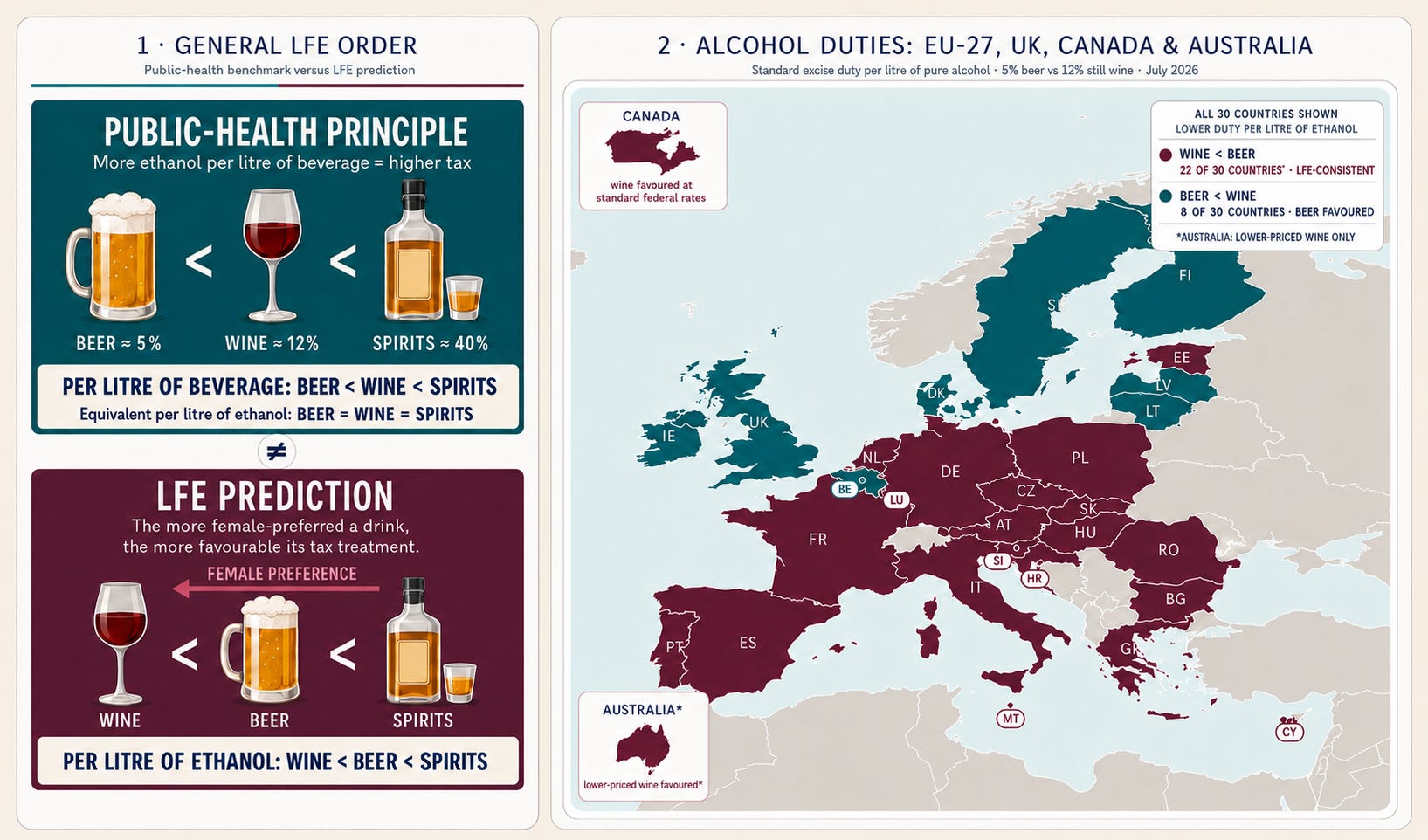
These amusing examples are not merely anecdotal. Even when the principles to which leftism appeals play a genuine role in political decisions, female preferences remain the final arbiter of their concrete application. If the LFE proves correct, identifying these preferences would make it possible to detect hitherto unknown asymmetries in the norms, markets, and laws of social-liberal societies; but also, and above all, to explain them. Conversely, leftist decisions that contradict the official principles of social liberalism should be explainable by underlying female preferences. In the final analysis, it is therefore not abstract principles that decide the matter, but female preferences translated into political language.
The example of true crime is particularly illuminating in this respect. Nothing in the conventional image of femininity suggested that women would consume narratives of murder, rape, or abduction on a massive scale. Yet the statistics do not lie: crime novels, podcasts, and crime documentaries are predominantly consumed by women. In social-liberal societies, such entertainment is also perceived as educational rather than violent content. By contrast, the fictional violence of action or shooter video games, a more masculine form of entertainment, is much more readily suspected of encouraging very real violence.
At the political level, this asymmetry is reflected, among other things, in age-rating systems. GTA V, for example, is rated PEGI 18, meaning that it is restricted to adults. Even Fortnite, despite its childlike aesthetic and absence of blood, is still rated ESRB Teen, meaning that it is prohibited for children under 13. At the same time, programs such as Faites entrer l’accusé, which unabashedly show bloody crime scenes, are generally deemed unsuitable only for children under 10. The World Health Organization, in its ICD-11 classification, also recognizes intensive video gaming as an addictive disorder. It must be said that this pastime is not especially appreciated by gamers’ female partners or by mothers. But when it comes to describing endless reading sessions, Netflix binges, or the compulsive consumption of crime documentaries as addictive, the WHO is nowhere to be found.
It is this correspondence between women’s attraction to true crime, on the one hand, and the political expressions that favor this form of entertainment, on the other, that makes it possible to conclude: true crime is indeed leftist, and therefore a natural female preference. At least, if the LFE is correct.
Of course, social-liberal societies still remain far from ideal leftism. Yet this distance does not render the LFE useless. If these societies do indeed converge toward this ideal, then the LFE makes it possible to formulate testable predictions. Understanding natural female preferences should therefore make it possible to predict the norms that social-liberal societies will adopt in the future. Returning to violent content, the LFE predicts, for example, that video games will continue to be regulated far more heavily than crime documentaries, notably through strict age-verification systems that will conveniently spare forms of entertainment favored by women. There is no need to wait: an asymmetry of this kind already exists in fiction.
In literature, for example, while true crime is certainly popular among women, romance stands out as their favorite literary genre. Whether in its sanitized young adult version or its more mature new adult variant, these works very often include erotic scenes. Some of these scenes would even be enough to make softcore pornography blush, despite the latter being restricted to those aged sixteen and over. Yet, in Western countries, the distribution of romance novels is subject to no age-rating system comparable to those applied to films or video games. These eroticized texts therefore remain freely accessible to everyone, without any particular restriction, including young teenage girls. The bestseller Fifty Shades of Grey, for example, is not even subject to a 13+ age restriction. Nor, for that matter, is the film adaptation, which France saw fit to restrict only to viewers aged twelve and over.
So far, the examples presented have mostly concerned micro-politics: pets, alcoholic beverages, entertainment... hence the temptation to regard them as secondary phenomena, almost unworthy of a general theory of leftism. That would nevertheless be a mistake. Modern societies undergo leftization precisely through the accumulation of minute trade-offs: a tax here, a subsidy there; the strict application of a principle in one case, followed by a reluctance to accept all of its consequences in another. Real-world leftism advances less through grand upheavals than through an infinity of administrative, economic, and cultural micro-adjustments.
Thus, by once again allowing plastic straws and high-flow showerheads, Donald Trump slows leftization more effectively than any ideologue. More importantly, no principle such as equality, environmentalism, public health, or safety can simultaneously explain all of the preceding trade-offs. To account for each case, a new principle would have to be introduced each time, followed by an ad hoc trade-off, before yet another exception came along to contradict the principle that had just been introduced. Leftism would then appear as a stack of thousands of partial and mutually inconsistent justifications. The LFE, by contrast, proposes a single and therefore parsimonious rule. If the LFE is correct, leftism must therefore genuinely be understood as the political expression of natural female interests and behaviors.
To be a complete theory of leftism, however, the LFE cannot limit itself to these everyday objects. It must also be capable of explaining the broad features of social-liberal movements. Support for environmentalism, for example, can be understood as the political expression of an obvious female interest in fauna, flora, and animal welfare. The OECD thus notes that women are more sensitive than men to environmental concerns, both in their consumption choices and in their willingness to recycle. Research in consumer psychology even shows that environmentally friendly behaviors are spontaneously associated with femininity, that is, with leftism. So much so that some men refuse to adopt environmentally friendly behaviors in order to preserve their masculine image.
If the social-liberal conception of environmentalism corresponds to its leftist form, modern societies should then prove more lenient toward pollution generated by female preferences than toward pollution generated by male preferences. The example of fast fashion is paradigmatic in this respect. Of course, an interest in fashion is not exclusive to women. Yet surveys and consumer studies show that women buy clothing more frequently than men, in greater quantities, and even regard shopping as a leisure activity. The women’s press goes so far as to speak of “retail therapy”, which says it all. Moreover, the CO2 emissions of the fashion industry, driven predominantly by fast fashion, are thought to be comparable to those of aviation and maritime transport combined. Thus, even leaving aside chemical pollution and water waste, the constant turnover of collections and the destruction of unsold goods make fast fashion particularly polluting.
What are modern societies doing to combat this pollution? So far, not much. In 2019, the British Parliament considered imposing an additional one-penny tax on every new garment sold: the recommendation was, of course, rejected by the government. In Sweden, a tax on chemical substances found in clothing and footwear was due to enter into force in 2022. It too was abandoned before being implemented. France, for its part, appeared to have adopted a firmer policy in 2024. A so-called anti-fast fashion bill did indeed provide for additional levies on companies in the sector, together with an advertising ban. The Senate, however, considerably weakened the text: it now primarily targets Shein and Temu, but not European retailers. Even the advertising ban was ultimately restricted to influencers alone. Is it really the environment that this ban seeks to protect, or rather the wallets of impressionable young women?
At the same time, Western societies have no difficulty heavily taxing large cars or private business jets. In other words, they have no difficulty making preferences that are more masculine than feminine bear the cost of environmental policies. By contrast, mass tourism enjoys much greater leniency, even though low-cost flights are themselves highly polluting. It must be said that travel now occupies an important place in the female imaginary: girls’ city breaks in Paris or Lisbon, yoga retreats in Bali, weekends in the Nordic countries... popular culture readily regards such trips as an almost obligatory step in the construction of the self. Conversely, more masculine destinations such as Las Vegas, Dubai, Singapore, or Shanghai are much more readily perceived as vulgar. The feminine is refined where the masculine is crude.
Limiting air travel to four flights over a lifetime, as Jean-Marc Jancovici proposes, is therefore nothing particularly leftist. It would amount to applying an environmental principle too consistently and therefore too indifferently to context. Yet female preferences are contextual by nature. As soon as a rule is applied uniformly, it inevitably ends up conflicting with other female preferences, at least as important as the one that inspired it. It is precisely at that point that the measure ceases to be fully leftist.
Radical environmentalism must therefore not be confused with leftism. A perfectly consistent environmentalism would go after not only supercars and private jets, but also fast fashion, mass tourism, cosmetics, hair dyes, pets, cut flowers, hot baths, takeaway lattes, sushi, a large share of home decoration, and even printed books. Such environmentalism might be right according to its own principles, but that would not make it any more leftist. If modern societies are indeed converging toward leftism, their political choices must instead be understood as trade-offs between different female preferences. Not as the ever more rigorous application of the grand principles to which they appeal, including when those grand principles have themselves been derived from the LFE.
This point bears repeating: the consistent and uniform application of a leftist principle is not leftist. Since female preferences are contradictory, leftism is equally so. Environmentalism provided a first example; the precautionary principle provides another. The latter directly echoes a female behavior well documented in psychology: risk aversion. Several meta-analyses indeed show that men engage, on average, in riskier behaviors than women. This difference appears equally in extreme sports, driving, investment choices, drug use, and sexual behavior.
It is hardly surprising, then, that social-liberal societies have sacralized the precautionary principle. The European Union, for example, has enshrined it in its primary law, in Article 191 of the Treaty on the Functioning of the European Union. France has even constitutionalized it through Article 5 of its Environmental Charter. It would nevertheless be naive to believe that this principle applies uniformly to the preferences of both sexes. Whenever it comes to obstructing nuclear power, GMOs, pesticides, or any other technology perceived as masculine, the precautionary principle imposes itself as dogma. When it threatens female preferences, however, that same principle becomes curiously much slower to apply, including when the health risks associated with those preferences are obvious.
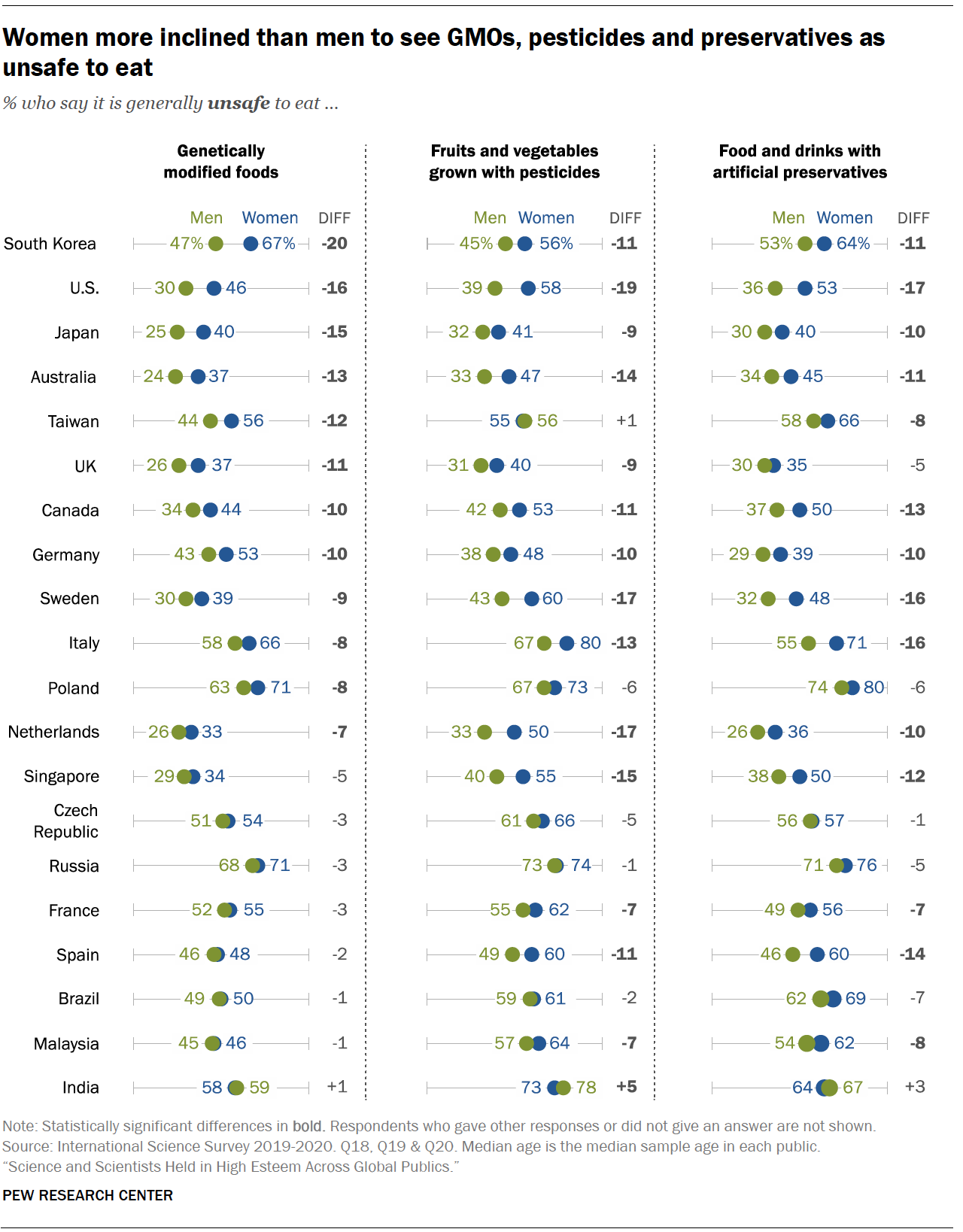
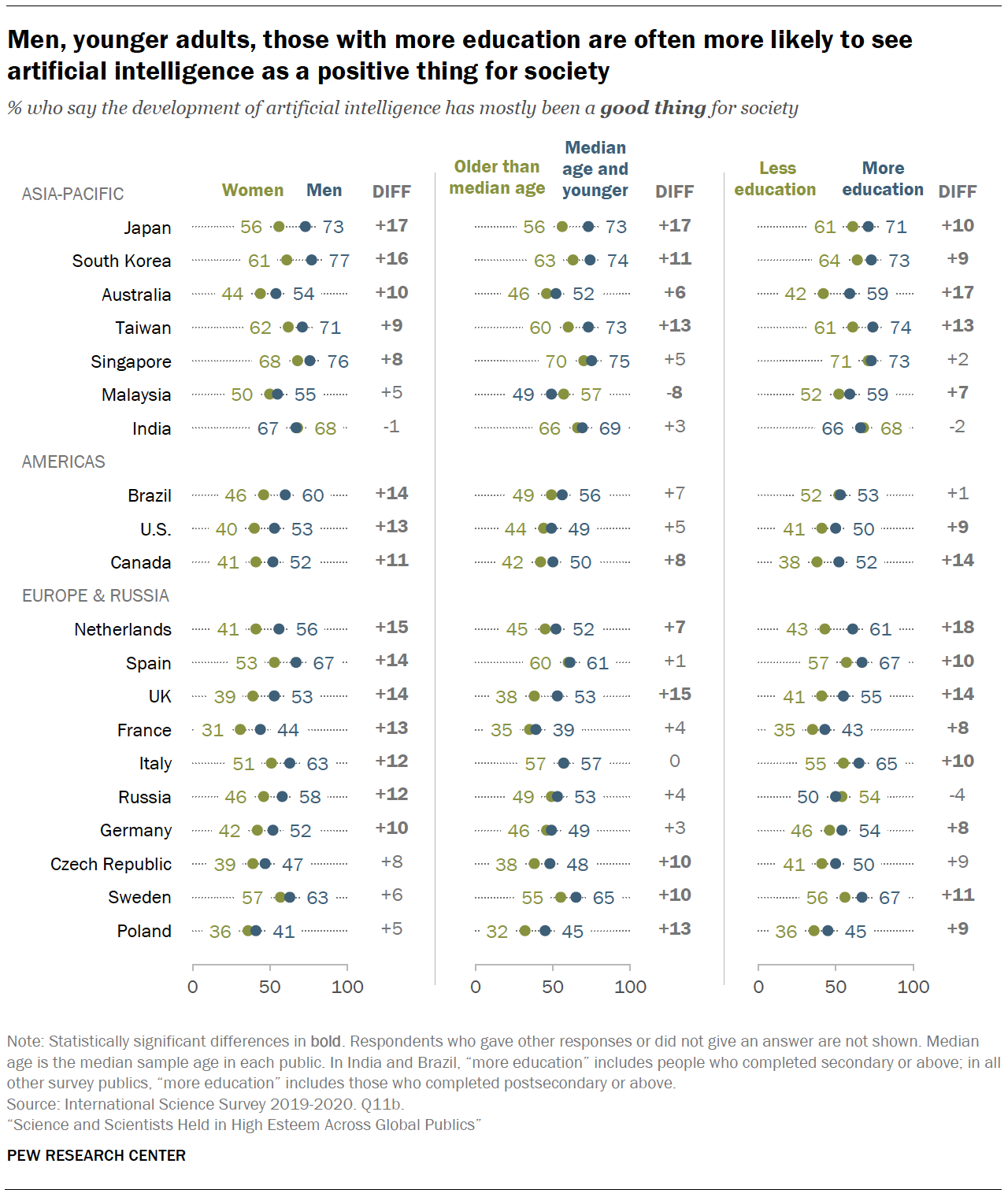
Everyone knows, for example, that exposure to UV radiation increases the risk of skin cancer. Yet modern societies still hesitate to ban tanning beds. In France, as early as 2012, ANSES considered the existing regulations inadequate and recommended their gradual prohibition. Fourteen years later, nothing has changed. What, then, of the UV lamps used for manicures? Will we have to wait another twenty years and dozens of meta-analyses before their potential danger is finally recognized? Yet this is precisely the kind of case in which the precautionary principle should, in theory, prevail.
If these examples are not mere coincidences, one question remains: why would modern societies converge toward the political expression of female rather than male preferences? After all, a rich, free, and safe environment allows the natural preferences of both sexes to express themselves. Western societies should therefore become more feminine just as much as they become more masculine, perhaps eventually tending toward an equilibrium. Why is this manifestly not the case?
Quite simply because men and women are not symmetrical. More precisely, the preceding objection rests on the idea that men and women differ only in a few preferences involving consumption, taste, or lifestyle. It would then be enough to compare the individual intensity of their respective preferences in order to infer their political influence. Yet evolutionary biology and psychology suggest that male and female preferences differ far beyond their mere content. They also differ in their capacity to aggregate, in the way the group that holds them defends them, and in the solicitude they elicit from others.
A preference can thus be very pronounced at the individual level without carrying any weight at the societal level. To carry political weight, it must also exhibit a certain degree of homogeneity, be capable of aggregating with neighboring preferences, be defended by the group that holds it, and elicit the solicitude of others. Only then can it become institutionalized, either through a law or through the convenient absence of one. It is from these structural asymmetries that the leftward drift emerges.
The first asymmetry is one of homogeneity: female preferences are, overall, less dispersed than male preferences. In differential psychology, the greater male variability hypothesis indeed shows that, for many measured traits, the male distribution spreads more widely around its mean than the female distribution. This difference matters all the more because individuals never vary along a single axis, but across numerous and relatively independent dimensions. A small difference in dispersion, repeated across a large number of relatively independent dimensions, produces considerable overall disparities. It is these small differences in variability that, once compounded, give male profiles a far more heterogeneous character than female profiles.
The second asymmetry is one of solidarity: women show greater solidarity toward other women than men do toward other men. This difference is well documented in social psychology, notably through the sex-specific in-group bias. Evolutionary theories of sexual selection and parental investment provide a complementary explanation: because women bear most of the reproductive cost, beginning with pregnancy, they are more selective in their choice of partner. To be chosen, men must therefore prove their value to the opposite sex. It is this selection pressure that pushes them to compare themselves, arrange themselves into hierarchies, and seek to stand out. In other words, to adopt more competitive and more individualistic behaviors than women.
These two asymmetries, moreover, mutually reinforce one another. On the one hand, female preferences are more homogeneous and aggregate more easily than male preferences. On the other, male preferences are more heterogeneous and compete more strongly with one another. The LFE immediately transposes these differences from the individual level to the societal level, making leftism a relatively unified ideology: a kind of limit-leftism, incoherent in its content yet nevertheless all of a piece. It is this unity that makes it possible to understand the leftward drift as the convergence of modern societies toward this same limit-leftism. It follows that the differences between left-wing movements diminish as each of them advances. To the point that it is now becoming difficult to distinguish Macronian leftism from Justin Trudeau’s Canadian leftism, or from that of the Nordic countries.
Symmetrically, transposing male preferences to the societal level would require a Right-Male Equivalence, that is, a male analogue of the LFE. Yet, because of the asymmetries described above, this equivalence would not give rise to a single rightism. It would instead produce a plurality of competing rightisms. Moreover, sex differences in solidarity and competitiveness make coalitions between these rightisms far more difficult than coalitions between left-wing movements. Thus, according to the LFE, the ease with which left-wing movements form alliances, faced with rival rightisms that struggle to form a united front, follows directly from these two asymmetries. By virtue of its relative unity alone, leftism therefore enjoys a major political advantage in winning the ideological battle.
Why, however, would modern societies converge toward this limit-leftism rather than toward a coexistence between leftism and rightist movements? This is where the third and final asymmetry comes into play: the asymmetry of solicitude. Men show greater solicitude toward female preferences than women do toward male preferences. Whereas the first two asymmetries give leftism its unity, this third one provides its driving force. This asymmetry of solicitude manifests itself notably in the women-are-wonderful effect, that is, the tendency among both men and women to attribute more positive qualities to women than to men. It also appears in more concrete biases, visible even within institutions. At school, for example, girls receive higher grades than boys at comparable levels of performance. In criminal justice, women are less likely to be incarcerated and receive lighter sentences for equivalent offenses. Even in the face of suffering, female distress more readily elicits the empathy and protection of others than male distress.
Here again, evolutionary psychology explains the origin of this asymmetry fairly simply. Because they bear most of the reproductive cost (pregnancy, breastfeeding, and early maternal investment), women are, on average, more selective than men in their choice of partner. Men, if they are to be chosen as partners, do not really have the luxury of ignoring female expectations. They must understand what women desire, what reassures them, what worries them, and what repels them, then adapt their behavior accordingly. By contrast, because they possess a certain monopoly of pregnancy, women can more easily afford to ignore male expectations. The asymmetry of solicitude thus merely transposes, at the individual level, an asymmetry already present in the size, cost, and scarcity of gametes.
As with the other two asymmetries, the LFE immediately transposes this asymmetry of solicitude to the societal level: in a rich, free, and safe society, leftization remains far easier than rightization. All modern societies therefore naturally tend toward the limit-leftism described above. The left rushes toward it with such zeal that its own positions from the early 2000s now appear suspect to it, if not openly reactionary. The various rightisms, for their part, have no choice but to follow the movement with a time lag, resignedly ratifying reforms they had still been fighting only the day before.
In the late 1990s, for example, the French governing left asserted that the PACS would never pave the way for marriage or adoption for same-sex couples. Fourteen years later, François Hollande’s left enacted same-sex marriage. No right-wing movement would dare propose abolishing it today. This is how the leftward drift transforms the radical demands of yesterday’s left into the irreversible gains of today. Until the next leftist demand.
In practice, however, the leftward drift is not realized solely through the introduction of new norms. It also proceeds, and perhaps above all, through selection. Social-liberal societies inherit an immense stock of norms already in place. While some of these rules are amended, weakened, or repealed, others pass through the ages without the slightest difficulty. What do these surviving laws have in common? They align with female preferences, even if only accidentally. It follows that the political orientation of a law cannot necessarily be inferred from its historical motivations. This is also what explains why parties officially opposed to leftism so often end up adopting measures that conform to it.
The German tax on dog owners, which so conveniently spares cat owners, offers a striking illustration of this process of selection. Introduced nearly two centuries ago to replenish municipal coffers, it was obviously never intended to satisfy any particular female preference. Yet this fiscal asymmetry has survived to the present day, even though the proliferation of domestic cats and their ecological impact would provide good reasons to make it symmetrical. Better still, in some places it has even been strengthened through additional taxes on dogs deemed dangerous, but still not on cats. This tax has therefore done more than merely survive the test of time: it has evolved in the direction predicted by the LFE.
Conversely, norms incompatible with female preferences, such as the impossibility of divorce, the prohibition of abortion, or primogeniture, have been abolished almost everywhere. This relative ease of leftization can even be observed in newly adopted norms. How, for example, can a Trump administration combat cocaine trafficking through airstrikes on the one hand, while relaxing the rules surrounding cannabis or psilocybin on the other? Have Republicans suddenly discovered the virtues of psychedelics and the harms of performance-enhancing drugs? Or must we simply recognize that, by force of circumstance, it is always easier to undergo leftization than rightization?
According to the LFE, social-liberal societies should consequently continue to undergo leftization over time. This should occur even in the most trivial corners of everyday life, through the transposition to the societal scale of female preferences observed at the individual scale. Femininity thus expresses locally what leftism expresses globally, and vice versa. It is this correspondence between two levels of expression that the LFE invites us to take seriously. The three initial questions were therefore not absurd at all: while the avocado, the cat, and yoga are not leftist in themselves, the favorable treatment they receive from the cultural norms, markets, and laws of modern societies certainly is. Moreover, this correspondence should appear most clearly in those domains where the natural interests of the two sexes diverge most sharply.
Yet no domain pushes this divergence further than reproduction. It is therefore in reproductive law that the LFE’s explanations and predictions should be most evident. From conception to parentage, by way of abortion, the next article will show that social-liberal societies have in fact already encoded female preferences to a considerable extent in their law. The grand principles usually invoked, such as bodily autonomy, the non-commodification of the body, or the best interests of the child, are not the true driving forces behind these rules. What leftism actually seeks to maximize is women’s decision-making power at every stage of the reproductive process. In other words, leftism aspires to institute a genuine female monopoly of pregnancy.