This page clarifies the most common misunderstandings about the Left-Female Equivalence, or LFE. For a brief introduction to the theory, begin with Start Here. For definitions of its main concepts, see the Glossary.
I. Isn’t the LFE merely the voting gender gap?
II. What counts as a natural female preference?
III. Why not simply say that female interests influence leftism?
IV. Why speak of “leftism”?
V. Is a predominantly female domain automatically leftist?
VI. Is the Left-Female Equivalence a circular theory?
VII. What would weaken the LFE?
VIII. Do rightisms coincide with anti-leftism?
I. Isn’t the LFE merely the voting gender gap?
No. It is the opposite: the voting gender gap is a direct consequence of the LFE.
More generally, the LFE does not reduce femininity to biological sex alone. First, because no woman embodies the totality of natural female interests and behaviors. Second, because individual variability guarantees that some men are more feminine than some women, and vice versa. The LFE thus predicts that the preferences of leftist men correspond more closely to female preferences than those of non-leftist men. Sometimes, even more closely than those of non-leftist women.
The existence of so-called strongly leftist traits illustrates this idea. These are natural female traits adopted more frequently by leftist men than by right-wing women. In survey form, such a trait often follows the following distribution:
left-wing women > left-wing men > right-wing women > right-wing men
In that case, political orientation, that is feminine preferences according to the LFE, clearly outweighs biological sex. This is why the LFE fully accepts the distinction between sex and gender. In fact, this makes leftism a form of genderism.
This distribution is seen in several American polls, using Republican and Democratic identification as a useful, though imperfect, approximation of rightism and leftism. This is the case, for example, with the belief that women still face systemic barriers hindering their success, the conviction that the decision to have an abortion should be solely a woman’s choice, or support for strict gun control. Even more amusingly, hostility toward male safe spaces turns out to be a strongly leftist trait… just like enthusiastic support for their exact female equivalents.
II. What counts as a natural female preference?
Quite simply, whatever women desire or tend, on average, to prefer. This may be a behavior, an object, a hobby, or even a demand they place on themselves or on the opposite sex.
A preference may, however, be represented in equal (or nearly equal) proportions among men and women. It is then both masculine and feminine and, at the societal level, as generically rightist as it is leftist.
In such a case, invoking femininity to explain why socio-liberal societies adopt or institutionalize this preference is not necessarily required. This is, for example, the case with the preference for pizza cut into triangular slices. However, when such a preference conflicts with a proclaimed principle of leftism, the LFE becomes explanatory again. The death penalty in certain cases of sexual crimes against children, in particular, conflicts with a principle allegedly dear to leftism: its universal abolition. Yet in a poll conducted in the United States, 61% of women and 59% of men said that the death penalty should sometimes be allowed in cases of child sexual abuse. The LFE therefore predicts that leftism could, in the future, reinstate the death penalty in this specific case. Or, at the very least, introduce life imprisonment without parole.
Because the LFE preserves the ordering of preferences, a preference can be relatively more feminine than masculine without necessarily being more common among women. The degree of leftism is therefore much easier to compare within the same domain of life than across different domains. Cannabis or psychedelic use is one example: it remains predominantly masculine, yet is still more feminine than steroid or methamphetamine use. The same remark explains why, even when a preference is not shared by a majority of women, differences in preferences between men and women generally remain instructive.
Finally, a natural interest or behavior may very well harm the person who expresses it. Leftism, as the political expression of natural female interests and behaviors, is therefore not necessarily in women’s interests.
III. Why not simply say that female interests influence leftism?
Because the claim that female interests merely influence leftism is too weak.
To say that female interests influence leftism would be to make them one factor among others, on the same level as economic, religious, or national interests. The LFE claims much more: in an ideally leftized society, there is a perfect correspondence between female preferences and the cultural norms, the markets and the laws prevailing within that society.
Thus, if women prefer cats to dogs, leftism should do the same, by treating cats with more indulgence than dogs: fewer taxes, fewer constraints and less punitive environmentalism.
Conversely, if leftism grants more empathy to suffering people than to accomplished people, the LFE invites us to look for a corresponding female trait. In this case, a tendency to value suffering for its own sake rather than for the reaction to it.
Obviously, this strong thesis implies neither that women consciously designed every leftist political expression nor that they secretly conspire to impose them. Leftization is an emergent phenomenon that results above all from the three fundamental asymmetries between the sexes.
Moreover, in practice, leftization operates primarily through selection: the cultural norms, markets, and laws that withstand the test of time tend to be those compatible with female preferences. Conversely, political expressions incompatible with these preferences tend to be amended in the direction predicted by the LFE, or even repealed outright.
IV. Why speak of “leftism”?
Very concretely, because social liberalism and progressivism belong to the political family conventionally identified with the left. The use of the term leftism acknowledges the continuity between this political family and the abstract limit toward which social-liberal societies appear to converge.
This terminology is however justified by deeper reasons. In modern societies, political parties aggregate the preferences of both men and women. Yet, because of the asymmetries of variability and solidarity between the sexes, female preferences aggregate more easily than male preferences. They therefore form a relatively unified political pole, structured around the defense of female interests.
If female preferences are realized in a unified pole, opposition to that pole can only be realized through other types of preferences. It therefore necessarily involves a share of masculinity. Yet, because of greater male variability and competitiveness, these opposition movements do not aggregate into a single party. They instead structure themselves in two ways: through rejection of female preferences, or through the promotion of particular male interests.
It remains to name these poles. The duality of the sexes naturally calls for the duality of “left” and “right.” Moreover, in many languages, the term right is associated with rectitude, correctness, or authority, that is, with traits associated with masculinity. Even in English, to be right means to be correct. French itself contrasts adroit and gauche, that is, skillfulness and clumsiness. Yet in the common imagination, clumsiness often carries a feminine connotation. In Latin too, dexter, the right, gave rise to “dexterity,” while sinister, the left, gave rise to “sinister.” From German to Hungarian, and through Hebrew as well, “right” and “left” are respectively associated with masculinity and femininity. Hence, the political expressions of female preferences may naturally be called “leftism,” and those of male preferences “rightisms.”
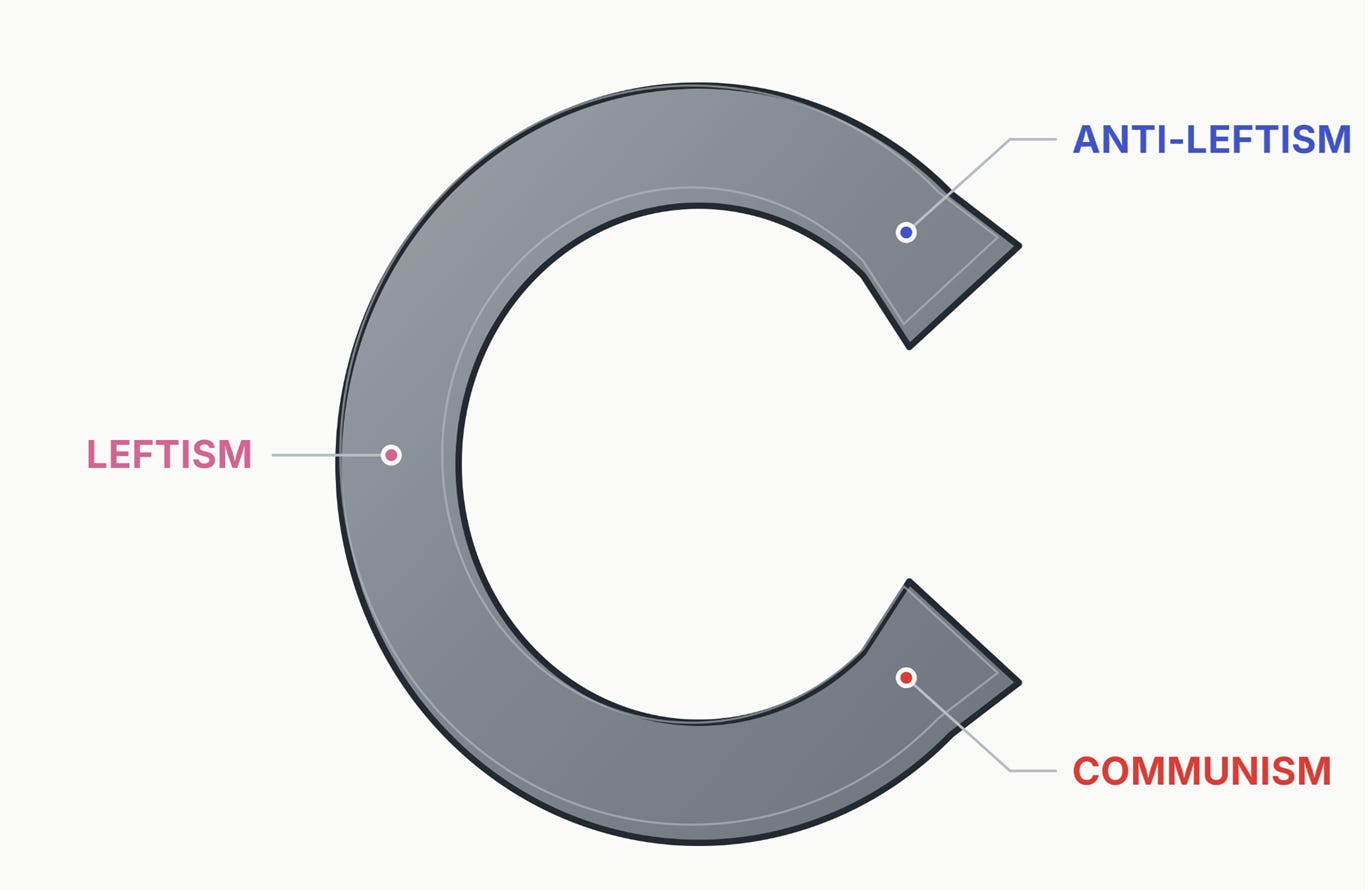
As for the movements usually described as far left (Marxism, Khmer Rouge, radical environmentalism, radical feminism, wokism or the queer movement) they obey a common mechanism: they rationalize an isolated part of femininity in a radical way. Yet this radical rationalization is a typically masculine behavior. These so-called far-left movements therefore emerge through the masculinization of a feminine intuition. They thus amount to a hybridization between female preference and male preference: neither rightist nor leftist. The LFE even describes them as communisms, in a very precise sense.
Under this interpretation, the relevant political axis no longer runs from the far left to the far right. It instead stretches from communism to anti-leftism, placing ideal leftism at the top of a horseshoe turned toward the left.
V. Is a predominantly female domain automatically leftist?
No. Strictly speaking, what is leftist is not an activity or a domain in itself, but the treatment that socio-liberal societies reserve for it. Moreover, this political treatment is classified according to its alignment with natural female interests and behaviors, rather than according to the demographic composition of the domain concerned.
An activity can therefore be mostly, or even exclusively, practiced by women without itself being leftist. This is notably the case with prostitution, grid girls, and trade-show hostesses. These activities primarily respond to male preferences because they embody a form of femininity shaped by the male gaze. Favoring them would therefore be generically rightist.
Conversely, an activity can be mostly practiced or consumed by men and still be leftist. Electric and autonomous vehicles, for example, are still bought disproportionately by men. Their favorable political treatment nevertheless expresses natural female interests in safety, comfort, and environmental protection, all of which are more feminine than masculine. Socio-liberal parties and left-wing media are likewise mostly led by men, yet still respond to female preferences. They are therefore leftist in the sense of the LFE.
Even norms imposed on men should converge toward female preferences. In aesthetic norms, for example, the gradual decline of suit-and-tie seems to reflect a female preference for smart or business-casual attire. Likewise, virtually no leftist politicians nowadays wear thick beards, which seems, here too, to reflect a female preference for clean-shaven faces or controlled stubble.
VI. Is the Left-Female Equivalence a circular theory?
Like every equivalence, the LFE can be used circularly if used carelessly. If leftism is identified only from femininity, and femininity only from leftism, the theory loses its explanatory value. To avoid this, the two sides of the equivalence must first be anchored independently, even if only roughly.
On the leftism side, this independent anchor is made possible by the leftward drift: independently of any claim about femininity, rich, free, and safe societies tend to converge toward similar laws, norms, markets, and political trade-offs. This convergence defines a limit-leftism that can be inferred without first invoking female preferences.
On the female side, the independent anchor is the study of female preferences themselves, through polls, market studies, scientific literature, consumption data, occupational choices, and aesthetic preferences. Even ordinary intuition is often enough, provided it is used cautiously.
It is only when these two independently identified sides coincide that the LFE proves correct. Three methods are possible for establishing this correspondence.
The first method is by direct verification. In this case, female preferences and political expressions are identified independently of one another. If the two coincide, the LFE is strengthened. If not, one side has to be revised.
For example, women are on average attracted to introspective practices, emotional language, and various forms of therapy. Meanwhile, modern societies seem to be evolving precisely in a direction that gives ever greater importance to mental health, feelings, vulnerability, and so-called emotional intelligence. To the point of introducing empathy classes in schools.The second method proceeds by deduction, from female preferences to leftism. This is often the most useful direction. When two preferences are clearly ordered on the female side, the LFE predicts that the corresponding political expressions should be ordered in the same way. If women prefer lattes and bubble teas to energy drinks, for example, socio-liberal societies should then treat lattes and bubble teas more favourably than energy drinks, whether in its public image, in scientific studies, or in the tax code.
The LFE can thus explain, and even uncover, political asymmetries that would otherwise remain unexplained. And if no political translation yet preserves this female order, the LFE becomes predictive. This is precisely what makes the LFE above all a theory of leftism, rather than a theory of femininity.
The third method proceeds by induction, from leftism to female preferences. This is the most delicate direction. Sometimes a political asymmetry is clearer than its corresponding female preference. In such cases, the LFE can reveal a female trait that has not yet been properly measured. But this use does not validate itself. The trait thus inferred must then be confirmed independently, through other data or evidence.
Socio-liberal societies, for example, tend to treat true crime with more indulgence than first-person shooter games. The female attraction to true crime may therefore not be a mere fashion trend, but the expression of a natural preference.
Avoiding circularity is however not enough: the LFE must also avoid cherry-picking. This is why the deductive method is ideal. It identifies a female ordering without knowing in advance the corresponding leftist ordering on the societal side.
In any case, each side of the equivalence thus constrains the other, allowing the two sides to test and correct each other. This is how the LFE avoids becoming a circular and empty theory.
VII. What would weaken the LFE?
The LFE would be weakened if rich, free, and safe societies systematically converged toward cultural norms, markets, and laws that protect male preferences inherently at odds with female preferences. The mere safeguarding of a male preference would not, however, invalidate the LFE, since such a preference might well be shared by women. In fact, as the world leftizes, male behaviors increasingly tend to align with female expectations.
The LFE would also be weakened if supposedly leftist political expressions repeatedly failed to correspond to any independently identifiable female preference.
More concretely, the LFE would be severely weakened if socio-liberal societies began to dismantle one of the most important female preferences: the monopoly of pregnancy.
VIII. Do rightisms coincide with anti-leftism?
No. A rightism is the political expression of a specific masculine preference. By contrast, anti-leftism is defined exclusively by its opposition to leftism, independently of any affinity with masculinity. Yet masculine preferences are not always incompatible with natural femininity. Some even align with it perfectly.
This is the case, for example, with subsidizing female contraception. On the one hand, such a subsidy increases women’s control over conception, thereby strengthening the monopoly of pregnancy; on the other hand, it allows men to avoid unwanted fatherhood. Such a measure is therefore both leftist and generically rightist.
The same applies to a right to repair limited to tractors and industrial machinery. By strengthening private property and technical autonomy, this limited right to repair clearly satisfies a masculine preference. Yet the act of repairing also satisfies a female desire for preservation and waste reduction. The measure is therefore both rightist and leftist, but not anti-leftist.
Conversely, a political expression can be anti-leftist without being rightist. Leftism, for example, taxes spirits more heavily than beer, and beer more heavily than wine. An anti-leftist inversion of this order would therefore tax wine more heavily than beer, and beer more heavily than spirits. Yet such an inversion would satisfy no masculine preference. It would merely mechanically invert a feminine preference.
More amusingly still, pushing this inversion to the extreme, by subsidizing spirits and beer but not wine, would end up becoming rather rightist. What would make it rightist here, then, is not the radicality of the inversion, but the fact that it would answer a masculine interest for beers and spirits.