
On social media, the Where do you draw the line? poster regularly resurfaces to fuel debate. Its principle is simple: line up different animals along an axis running from pet to food, then ask readers to draw the line beyond which they are willing to see an animal end up on their plate. But where, exactly, does leftism draw that line?
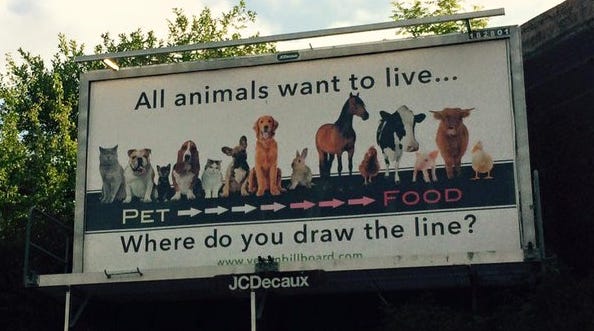
Before answering this question, a few amusing observations are worth making. First, the axis running from pet to food is oriented from left to right, in almost too perfect an agreement with the LFE. Next, the cat is positioned furthest to the left on the poster, as though to confirm its status as the most leftist pet one can own. Finally, which animal sits furthest to the right? The duck: a bird certainly appreciated by women for its cuteness, but one that no one is particularly reluctant to eat. Especially during the holiday season.
The image nevertheless contains an obvious inversion that will escape no lover of gastronomy: the rabbit appears to the left of the horse. Yet, of the two meats, horse meat is clearly the one that has already disappeared from our plates. In France alone, in 2025, households consumed ten times more rabbit meat than horse meat. Horse-meat consumption even fell twentyfold between 1970 and 2020, which says it all. It therefore took less than fifty years to move the horse from food to pet.
This cultural evolution has nevertheless yet to find expression in law. In France, a bill did indeed propose reclassifying the horse as a “companion animal”, but it has so far failed to pass. Its stated objective? Quite simply to ban the slaughter of horses and the consumption of their meat. In short, formally drawing the line to the right of the equid. Had this measure managed to prevail, it would have swept aside, with a wave of the hand, a well-documented anthropological reality: human beings have been eating horse meat for more than 480,000 years. By contrast, horses have been used as draught animals or mounts for barely 5,000 years. How, then, can this rather recent sacralization of the horse be explained?
The LFE offers an answer almost too simple to be true: leftism is the political expression of female preferences. If this hypothesis is correct, the leftization of modern societies should then be accompanied by a progressive alignment of eating habits with those same preferences. Yet all surveys agree on one point: women are far more reluctant than men to eat horse meat. In France, in particular, a 2012 Ipsos MORI survey showed that only 39% of women considered it acceptable to eat, compared with more than 61% of men. These disparities are in fact by no means unique to France and can be observed identically in Belgium and the Netherlands.
Female attachment to equids can also be seen in the changing demographics of horse-riding participants. Still in France, the share of women among licensed members of equestrian clubs rose from 53.4% in 1975 to nearly 85% in 2022. It was therefore at the precise moment when horse riding established itself as an eminently female pastime that the horse disappeared from our plates. Funny coincidence.
There is, however, one major omission from the original poster: fish, and salmon in particular. Why this omission? Because without salmon, women would have to bid farewell to a dish they are particularly fond of, namely sushi. Indiscriminately banning all animal flesh, fish included, would therefore push female attraction to living things far beyond its natural range. The vegetarian diet consequently does not maximize the level of leftism. Rather, it is a synthetic diet in the sense of the the previous essay on leftist inconsistency: a rationalization that ultimately contradicts the preferences it initially claimed to defend.
What, then, of the vegan diet? It is more extreme still than vegetarianism, since it goes so far as to prohibit the consumption of eggs and milk. Suffice it to say that, to comply with it, women would have to give up the cupcakes, lattes, fruit tarts, and other cheesecakes they adore. And that is without even considering the fact that it is neither practical nor healthy. Thus, rather than being leftist, the vegan diet is so synthetic that it ultimately turns against women’s everyday pleasures. It is therefore a communist diet, in a very precise sense, belonging to radical environmentalism.
As for the most puritanical version of veganism, namely raw veganism, it advocates an exclusively raw diet and proves so extreme that even leftism now openly fights it. Its leading French promoter, Thierry Casasnovas, is moreover being prosecuted for quackery. Leftism therefore does not even tolerate its own synthetic excesses.
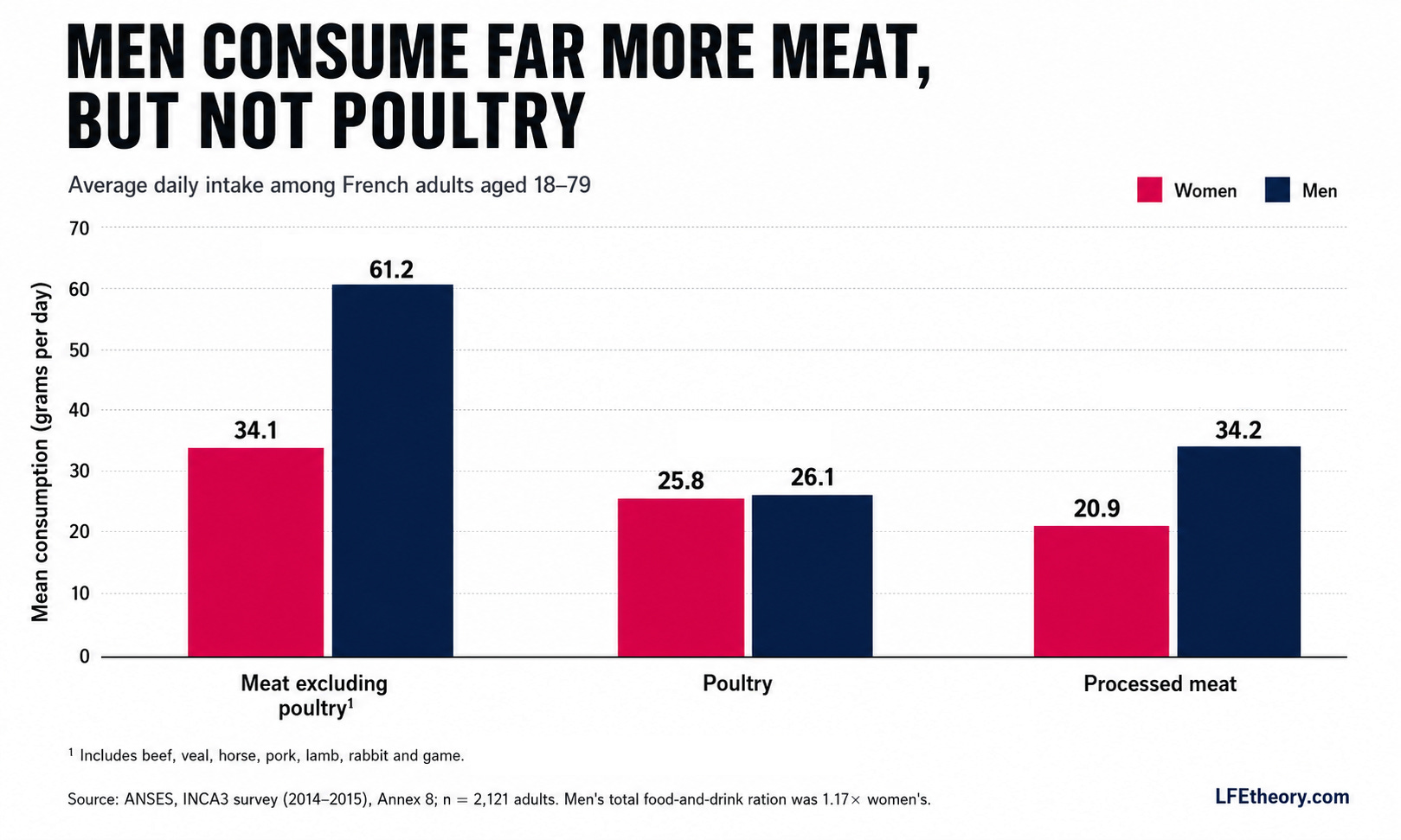
So where does leftism draw the line? To the right of the horse, obviously, while at the same time making sure to reduce the consumption of red meat, processed meats, and barbecue-grilled meat. After all, these foods are consumed by men up to twice as much as by women. It is therefore flexitarianism that embodies the most leftist diet.
As proof, campaigns encouraging people to consume ever more fish and white meat, and less red meat, are multiplying across all social-liberal societies. France goes further still, requiring school canteens to serve at least one vegetarian meal per week. One vegetarian day a week for leftism, then, versus every day for syntheticism. As for the rabbit, women regularly describe it as “cute” and “adorable”. Rabbit-meat lovers should therefore hurry to stock up before it disappears in turn. At least if the LFE is correct.