
According to the LFE, the leftist conception of equality is horizontalizing in areas where men enjoy an advantage at women’s expense. This principle underlies, in particular, sex quotas in politics, on corporate boards, and in academia. Horizontalization does not however stop at positions of power. It also intrudes into one of the most meritocratic and masculine spheres of all: competitive sport.
It is in tennis, a sport that women particularly enjoy as spectators, that this horizontalization is most clearly illustrated. For nearly twenty years now, all four Grand Slam tournaments have indeed offered identical prize pools for the men’s and women’s competitions. Yet the two tours are far from generating similar revenues or putting on a spectacle of the same calibre.
Take the 2026 Australian Open as an example. Across the tournament as a whole, the men played for 64% longer than the women. In terms of viewership, too, the men’s final attracted more attention, drawing nearly two-thirds more viewers than its women’s counterpart. Needless to say, the gap in total hours watched, on which advertising revenues directly depend, is considerable. But none of this matters to leftism: regardless of these differences in playing time or viewership, parity must be imposed by redistributing prize money from the men’s pools to the women’s.
This redistribution goes beyond the battle of the sexes, however: it now takes place within each draw, rewarding losers ever more generously. At the 2012 Australian Open, the champion pocketed 24.6% of the total prize money allocated to his draw. By 2026, the champion’s share had plummeted to 11.0% of the total.
Meanwhile, players eliminated in the first round are being paid more and more. Whereas the 2012 champion pocketed 111 times as much as a player who failed to win a single match, that ratio had fallen to 28 by 2026. In just fourteen years, the ratio between the champion’s payout and a first-round loser’s has therefore been cut by a factor of four. Tournament prize pools are thus being horizontalized in a literal sense.
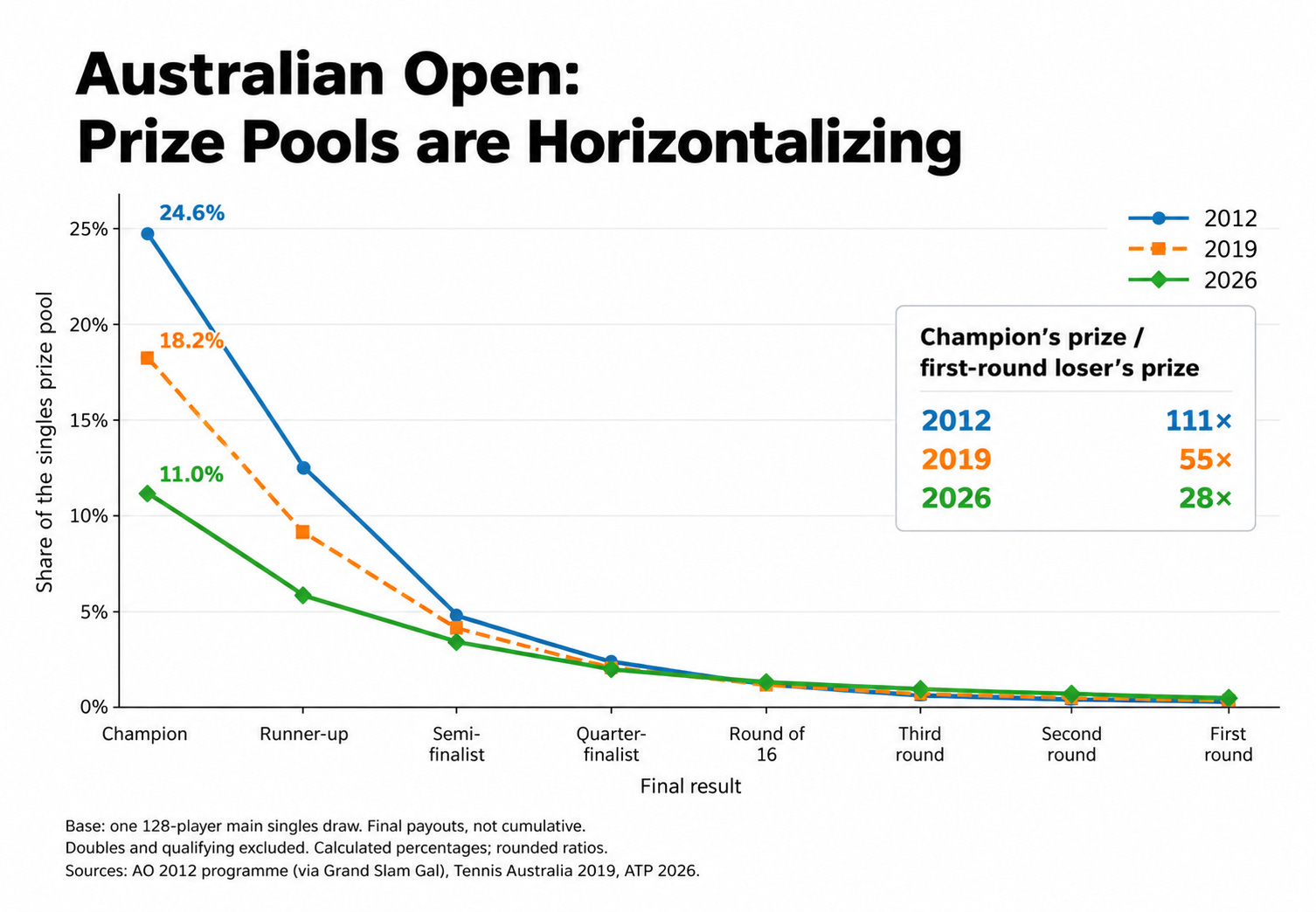
This redistribution from winners to losers is, in fact, openly endorsed by the organizers of the four Grand Slam tournaments. The official rationale is supposedly to allow lower-ranked players to “make a decent living” from the sport. The argument seems reasonable, except that a player losing in the first round of all four majors would now pocket more than $400,000. The real explanation for this redistribution must therefore lie elsewhere: leftization is advancing forcefully across the board. So forcefully, in fact, that even Federer, Djokovic, Nadal, and Murray have felt compelled to campaign for the horizontalization of their own winnings.
Nor are competitions popular with women the only ones affected by this horizontalization. The World Series of Poker is no exception, even though more than 96% of participants in its Main Event are men. More specifically, since 2016, the proportion of participants receiving a payout in most WSOP tournaments has risen from 10% to 15%. Even women’s events take part in this redistribution, such as the Ladies Championship. It is a mixed-sex tournament... with one small catch: the entry fee is $1,000 for women, but $10,000 for men. Clearly, the point is no longer to win, but to take part.
For if there is one thing well documented in behavioral economics, it is that women are much more willing to enter a competition when it comes with a safety net. In a study published in 2021, for example, 238 participants had to choose between individual, non-competitive pay and a tournament in which only the top two performers in a group of four were paid. When the rules allowed winners to redistribute part of their earnings to the losers, the proportion of women choosing the tournament rose from 34.8% to 60.3%. Among men, by contrast, introducing the safety net made almost no difference: their participation rate remained close to 50%.
Horizontalization therefore amounts to more than a simple transfer of wealth from men to women. Its purpose is rather to adapt the very conception of competition to female preferences. In particular, this means reducing the benefits the winner derives from victory, so as to make competition ever more inclusive and indulgent toward losers. The masculine conception of competition, based on a vertical hierarchy and impersonal rules, with rewards tied directly to performance, thus disappears as leftization progresses. And the rankings themselves need not even disappear. It is this redistribution of rewards to people who ultimately accomplish nothing that the LFE calls horizontalization.