
According to Article 6 of the 1789 Declaration of the Rights of Man and of the Citizen, all citizens are eligible for public office “without any distinction other than that of their virtues and talents”. In other words, access to positions of power should rest on merit alone. In France, this universalist conception of equality remained so firmly entrenched in 1982 that a law proposing sex quotas for municipal electoral lists was struck down by the Constitutional Council. This historical conception of equality, upheld by leftism at the time, thus rejected sex as a legitimate legal category: men and women were equal precisely because their sex did not count.
Yet this universalist, sex-blind conception of equality gradually gave way to its opposite. In France, for example, the 1999 constitutional amendment paved the way for sex quotas in politics through the well-known parity laws. Equality was now to be achieved not by ignoring sex, but by meticulously counting men and women and imposing quotas. This new conception of equality was even extended in 2008 to corporate boards and, more recently, to senior leadership positions in the civil service. Ironically, then, it was in the name of equality itself that sex once again became a legitimate legal category. Leftism thus shifted from a universalist and meritocratic conception of equality to a horizontalizing and interventionist one.
The universalist conception has not disappeared entirely, however. When it comes, for example, to narrowing the gap in life expectancy between the sexes, closing the educational achievement gap between boys and girls, or reducing the disproportionately high male suicide rate, leftism struggles to introduce policies aimed specifically at men. In these cases, rather than imposing quotas, it acts through universalist policies that target both sexes equally.
This raises a question: why does leftism meticulously count men and women in one case, yet refuse to do the same in another where sex differences are just as pronounced? The LFE’s answer is always the same: alignment with female preferences determines, case by case, which conception of equality leftism adopts. More specifically, the horizontalizing conception of equality, which counts men and women and rebalances their representation, prevails in areas where men enjoy an advantage at women’s expense. By contrast, in areas that naturally favor women, the universalist, sex-blind conception prevails. Leftism thus seeks to level out differences that serve male interests, while conveniently ignoring those that serve female interests. In some areas, it even indulges in verticalization, reinforcing hierarchies that align with female preferences. The purpose of this essay is to substantiate these claims.
One problem remains, however: at the individual level, female preferences depend on the context in which they are expressed. Transposed to the societal level, this dependence on context makes leftism an incoherent ideology, incapable of consistently applying the grand principles it claims to uphold. Worse still, a political expression’s degree of leftism is generally unstable under particularization: adding a seemingly innocuous detail is sometimes enough to reverse its political orientation. The leftist conception of equality is obviously no exception. Understanding it in detail would therefore require examining female preferences one by one, down to their most specific manifestations.
Fortunately, leftism nevertheless follows broad, recognizable patterns. According to the LFE, these patterns correspond to equally general female traits, described as global: female tendencies that manifest themselves across many areas of life without applying rigidly in every case. Previous essays have already illustrated three of them. The leftist conception of environmentalism, for example, stems from women’s attraction to naturalness; reproductive policies revolve around the monopoly of pregnancy, while the precautionary principle reflects women’s characteristic risk aversion.
By contrast, a specific female preference that appears only in a particular context is described as local. A fondness for cats or an interest in crime documentaries are good examples. In everyday life, women constantly weigh these global tendencies against their local preferences. The LFE claims that leftism makes precisely the same trade-offs at the societal level. This explains why leftism aggressively targets hunting but not cats, even though the latter kill billions of birds every year. More strikingly, it explains why leftism treats violent video games more harshly than true crime shows, even though the blood shown in the latter is real. The contradictions of leftism at the societal level thus arise from the tension between global and local preferences at the individual level.
Returning to the leftist conception of equality, it too corresponds to a global female trait: the horizontalizing tendency, or women’s propensity to reject masculine forms of comparison that rank individuals along a single axis. Compared with men, women indeed prefer horizontal organizations to highly hierarchical ones. This difference is evident even in their attitudes toward competition.
More specifically, women are much less inclined than men to enter individual competitions governed by impersonal rules. For one thing, competition reduces individuals to their place in a ranking: it inevitably produces winners and losers. For another, an impersonal rule, by definition, ignores each person’s experiences and circumstances. Worse still, the resulting ranking does not depend on the participants’ interpersonal skills. Numerous experiments in psychology and economics confirm this sex difference in attitudes toward competition. In the classic experiment by Niederle and Vesterlund, for example, participants performing a repetitive task must choose between piece-rate pay and tournament-based pay. Despite comparable performance, 73% of men choose the tournament, compared with just 35% of women.
The horizontalizing tendency concerns not only competition itself but also, and perhaps above all, its social dimension. Schram, Brandts, and Gërxhani showed, for example, that simply making performance rankings available to a third party is enough for men to improve their performance. By contrast, women’s performance remains unchanged whether or not those rankings are made public. Once the comparison becomes visible, men therefore redouble their efforts to improve their performance and gain status. This phenomenon is also readily understood from the perspective of evolutionary psychology: to stand out from other men, men have an obvious evolutionary interest in comparing themselves with one another and making their rank public.
In another series of experiments, Qiu and Kesebir examined precisely this social dimension of comparison. Their conclusions are unequivocal: women react much more negatively than men to rankings being made public. Why? Because they fear that making hierarchies explicit will damage interpersonal relationships. What bothers them, then, is not so much the ranking itself as the fact that everyone can see it. Publicly displaying hierarchies thus carries a relational cost that women seem far less willing than men to accept.
According to the LFE, leftism should therefore reproduce this horizontalizing conception of equality at the societal level. This is exactly what we see today in school grading scales. In France, for example, students have traditionally been graded out of twenty: a precise, quantitative scale. Today, the only scale permitted in official school records at the primary and lower-secondary levels is a qualitative scale with four descriptive ratings. A similar shift can be seen in Canada, England, and Norway. Unlike numbers, which immediately create a relation of comparison, words allow for a certain degree of ambiguity. A coarse scale, with four levels rather than twenty, also makes it possible to group more students into the same category. Leftist equality is thus achieved by blurring the very instruments that once made it possible to measure inequalities.
To prevent stronger students from distinguishing themselves from weaker ones, leftism even goes so far as to impose increasingly stringent restrictions on homeschooling. In France, for example, education is now compulsory from the age of three, and homeschooling requires official authorization. Sweden goes one better, banning all forms of homeschooling outright. All students are thus lumped together.
Horizontalization, however, is not limited to youth and now reaches even the most prestigious competitive examinations. The American medical licensing exam, the USMLE Step 1, no longer even distinguishes future doctors by a numerical score. Students are now assessed through the most rudimentary system imaginable: a binary “pass” or “fail” evaluation. In France, the INSP, the successor to the ENA responsible for training senior civil servants, has likewise replaced numerical grades with a qualitative four-level evaluation. Even its famous exit ranking has been abolished. Yet it was precisely this ranking that allowed the best students to choose first among the most coveted positions in the civil service.
It would nevertheless be misleading to think that horizontalization forbids putting people into categories. What leftism objects to is not so much the existence of these categories as their hierarchical ordering. After all, multiplying the criteria of evaluation is a particularly effective way of making any comparison ambiguous. A single score defines a single axis, and therefore a clear hierarchy. Multiple criteria, by contrast, can only be used to rank individuals if the way they are combined is made explicit. Yet leftism refuses to decide once and for all how those criteria should be combined. Comparing multidimensional profiles therefore requires a judgment call that depends on the context and the assessor: the comparison becomes subjective. Favoring profiles over rankings is thus another way in which the leftist conception of equality is realized.
This preference for profiles can also be explained directly through the LFE. Women do appreciate classification systems, provided they help them understand themselves better and do not rank individuals. Astrology, the MBTI, and love languages all fit this description: they classify people without ranking them. In one American survey, 35% of women reported believing in astrology, compared with just 18% of men. The figure reached 43% among women under fifty. Moreover, a Libra is not inherently inferior to a Leo, any more than an INTJ is superior to an ESFP. Each type thus has its own strengths and weaknesses, making it better suited to some contexts than others, with (supposedly) no basis for an overall ranking.
This explains leftism’s attraction to the theory of multiple intelligences. Popularized by Howard Gardner, this theory replaces the idea of general intelligence with several distinct forms of intelligence: everyone is supposedly intelligent in their own way, with no way to compare these intelligences along a common axis. Unfortunately for leftism, psychologists now widely regard this theory as a neuromyth. Nevertheless, it remains widespread in schools, precisely because it prioritizes profiles over rankings. In Quebec, for example, 68% of teachers believe that students have a dominant intelligence profile that teaching should take into account. The same holds in France, where official guidance continues to insist that teachers take Gardner’s different forms of intelligence into account.
If comparing students along a common axis is illegitimate, grouping them into classes by ability naturally becomes suspect. As for ability groups within the same class, these are now described as needs-based groups, a decidedly feminine choice of words. A student is thus no longer simply strong or weak: their needs vary across subjects and over time. Next come the institutions themselves, which are also assessed through profiles. Whether English secondary schools or European universities, they are now assessed against distinct criteria that are never combined into an overall score. Each institution thus becomes a profile, more or less suited to what each person is looking for, rather than a mere position in a ranking.
So far, horizontalization has mainly involved replacing rankings with profiles, rendering otherwise comparable individuals incomparable. But blurring the basis for comparison does not make selection disappear. Leftist selection in fact works by changing the criteria themselves. More specifically, it places ever greater weight on candidates’ interpersonal skills. Technical skills are thus supplemented by communication skills, teamwork, and networking ability. To the point that proficiency, despite being objectively measurable, becomes a secondary consideration. And what do all these leftist selection criteria have in common? They align more closely with female preferences than with male ones. Nor are these new criteria weighted in advance according to a fixed rule. Their relative importance therefore depends on the context and, ultimately, on the assessor: selection becomes discretionary.
Anonymous assessment, based on rules set in advance and applied equally to everyone, thus gives way to more context-dependent judgments. In schools, this shift translates into more group projects, oral presentations, and continuous assessment. Take the baccalauréat, France’s high school leaving exam: continuous assessment now accounts for 40% of the final grade. Students are thus assessed throughout the year rather than solely on their performance on exam day. Their behavior and ability to meet teachers’ expectations therefore count just as much as their technical skills. The baccalauréat also includes a Grand oral, an oral examination that puts communication and presentation skills center stage. And what does the French Ministry of Education require in its common core curriculum? Students must work “in teams”, “show diplomacy”, “seek consensus”, know how to “express their feelings and emotions”, and demonstrate “empathy and kindness”. In short, students are expected to adopt behaviors valued by women.
Even the layout of schoolyards is being rethought. The City of Paris, for example, proposes replacing the sports courts traditionally located at the center of lower-secondary schoolyards with social spaces equipped with benches and tables for conversation. Sports courts would thus be relegated as far from the center of the schoolyard as possible, ideally to its corners. They would also be completely redesigned to favor cooperative rather than competitive sports. Where leftism does not change the sports themselves, it makes the hierarchies they produce invisible. In Norway, for example, publishing rankings from sports competitions for children under eleven is banned outright. The same goes for Canada, where soccer competitions for children under thirteen have no published standings.
With schools so closely aligned with female preferences, is it any surprise that girls outperform boys? In France, as many as 50% of girls in a given age cohort obtain a general baccalauréat, compared with just 37% of boys. This female advantage then naturally carries over into higher education. Historically, however, men were far more likely to enter higher education. The situation has since been completely reversed. In 2024, 56.2% of French women aged 25 to 34 held a higher education qualification, compared with 49.9% of men in the same age group. This reversal is not unique to France: it can now be seen in most OECD countries, consistent with the LFE.
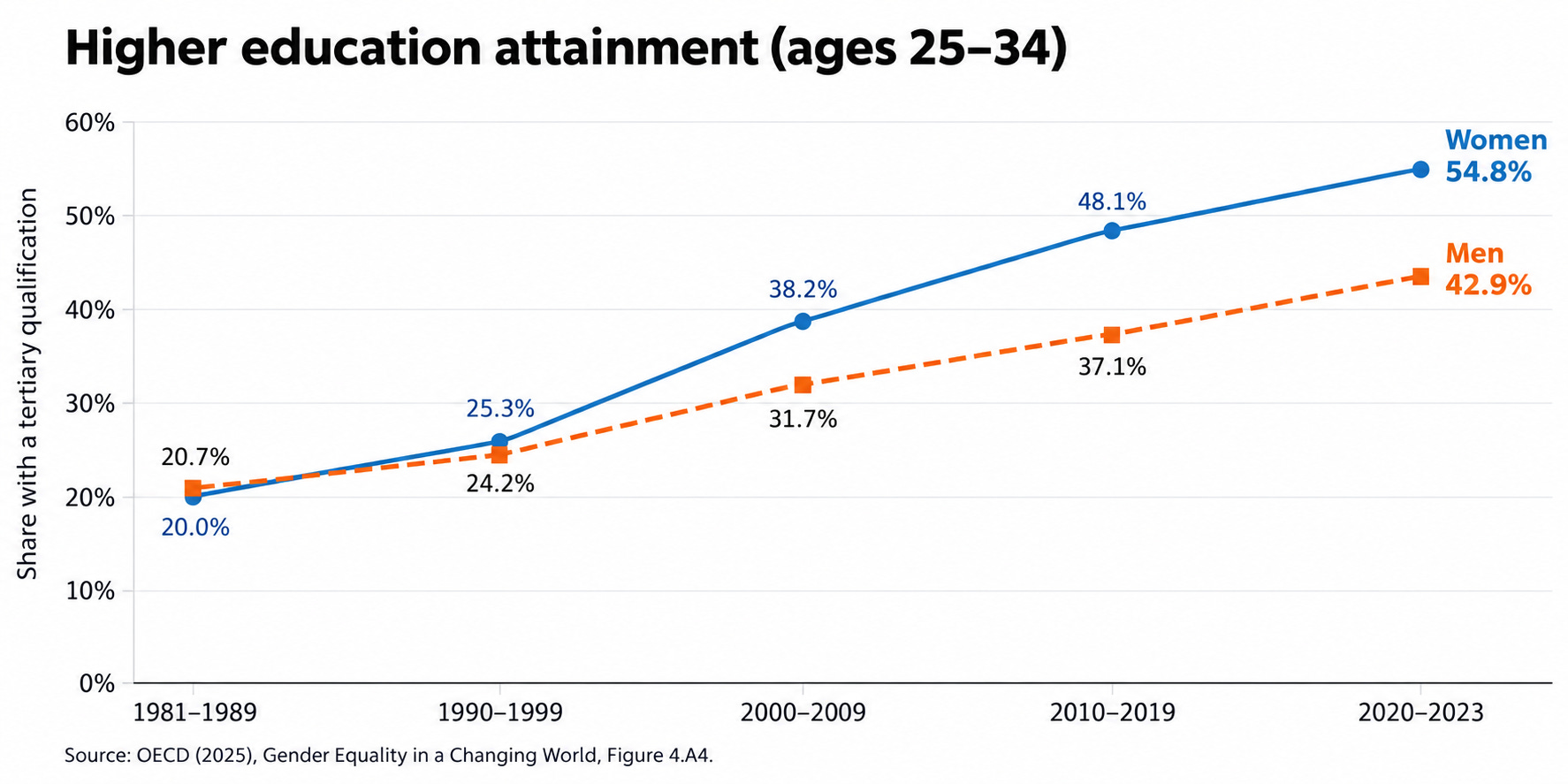
What, then, does leftism do to horizontalize this growing educational gap? Not much in fields that already favor women, such as medicine, psychology, or the judiciary. At France’s National School for the Judiciary, for example, 77% of trainee judges and prosecutors are women, which does not seem to bother leftism in the slightest. Yet as soon as the focus turns to fields where men are overrepresented, such as mathematics or physics, parity suddenly becomes a priority again. Leftism then no longer hesitates to introduce sex quotas, even for prestigious teaching or research positions. Suddenly, it is supposedly urgent to “rectify the situation” by explicitly favoring women. No doubt horizontalizing teacher recruitment in this way will eventually horizontalize their students’ academic performance as well.
To justify this asymmetry, leftism even goes so far as to devise biased metrics. The textbook example is undoubtedly the World Economic Forum’s Global Gender Gap Index. This metric purports to measure how far each country is from parity between the sexes. To do so, it uses various demographic indicators to compare the representation of women and men in areas deemed strategically important. On paper, the principle seems neutral. In practice, however, the female-to-male ratio is artificially capped at 1. Areas in which women are disadvantaged therefore lower a country’s score, while those in which they are advantaged do not. In the latter case, the index simply considers parity to have been achieved. Any female advantage is thus rendered invisible by construction. The irony? The Global Gender Gap Index produces a public ranking along a single, predefined axis. But since this ranking serves female preferences, leftism takes it seriously rather than horizontalizing it.
This shift from objective criteria to more context-dependent ones aligned with female preferences extends even to the corporate world. Employers are placing increasing emphasis on soft skills rather than hard skills. In a French survey published in 2018, 60% of employers reported giving more weight to behavioral skills than to technical skills. Yet it is hard skills that contribute most directly to productivity. According to the LFE, occupations suited to female strengths should therefore grow in importance as leftization progresses. Even when those jobs are held by men.
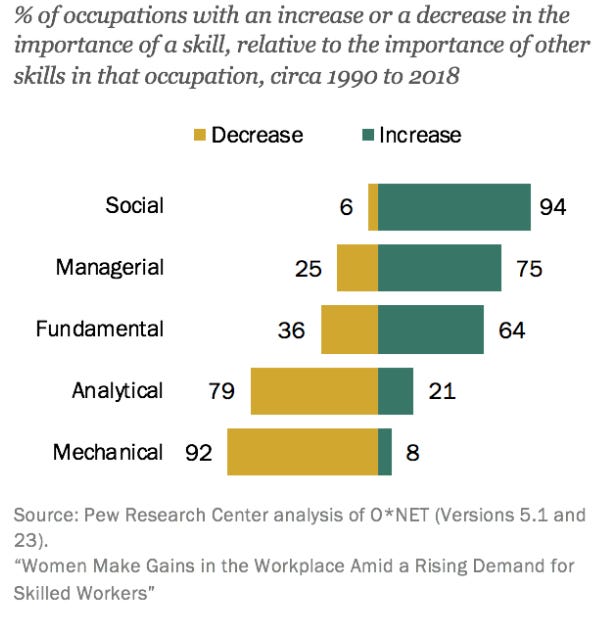
This shift from technical competence to interpersonal skills naturally extends to recruitment. For one thing, most recruiters today are women: they account for nearly 80% of human resources managers in the United States and 66% in France. And women place greater emphasis on soft skills than men do. For another, the recruiter’s sex itself influences who gets hired. In France, for example, when the person in charge of recruitment is a woman, women account for 51% of those hired. When it is a man, by contrast, this proportion falls to 41%. Thus, while the demographic feminization of a profession is not necessarily synonymous with its leftization, the two phenomena reinforce one another here.
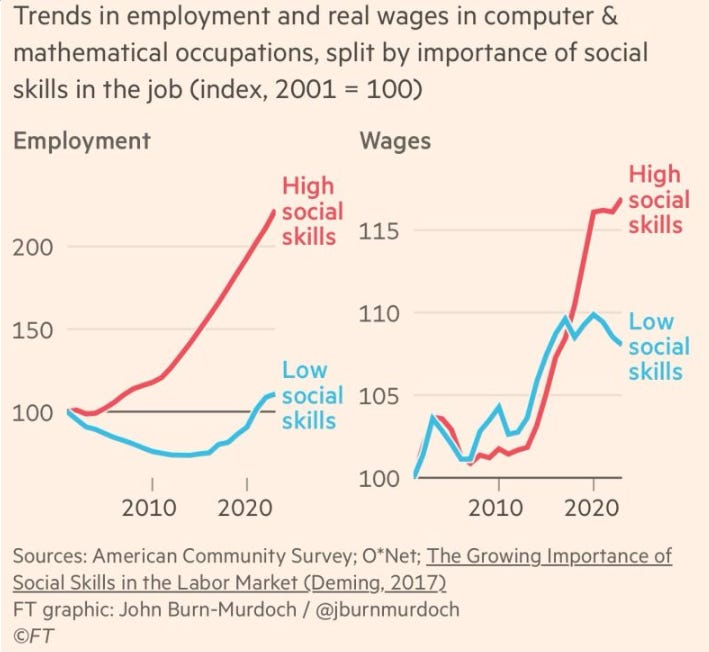
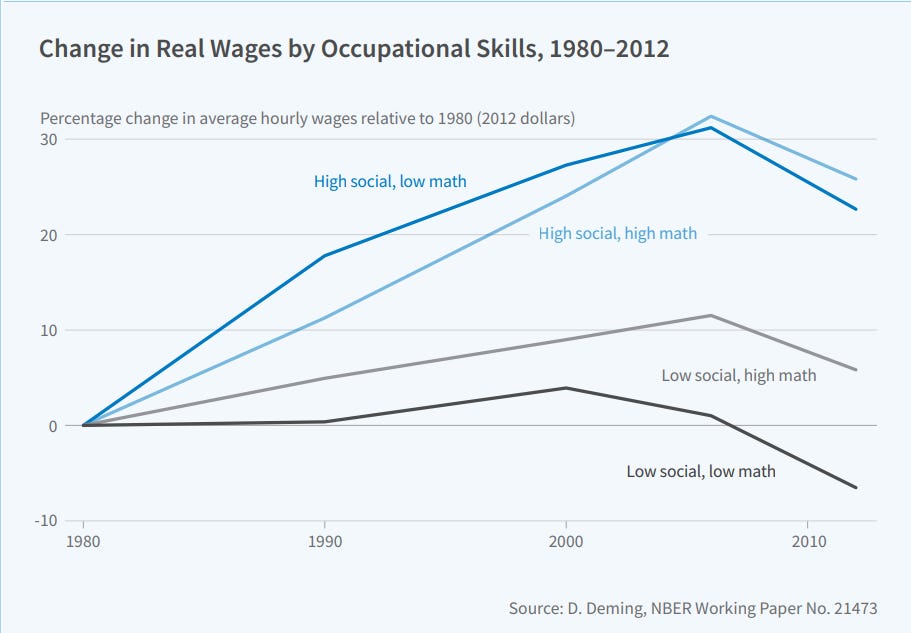
After recruitment, wages too begin to shift in line with female preferences. If the world really is aligning itself with these preferences, wages in occupations with a strong social component should rise faster than those in technical occupations. This is precisely what the figure below shows. Worse still, in occupations that rely on soft skills, being good at mathematics simply does not contribute to wage growth. There is therefore no wage premium for technical competence in these occupations.
Even performance bonuses are being horizontalized as leftization progresses. Alongside individual bonuses, a growing number of companies reward their employees with collective bonuses. Yet it is Adobe that takes horizontalization furthest. As early as 2012, the company abolished its rating and ranking system in favor of Check-in, a system based on regular conversations between employees and managers. As a result, salary increases and individual bonuses now depend exclusively on managers’ assessments. Not on objective metrics defined in advance. Rather than producing equality in practice, horizontalization has therefore once again shifted selection toward the discretionary judgment of evaluators. A judgment which, as before, is moreover based primarily on criteria aligned with female preferences.
Horizontalization also manifests itself in a more unexpected way through the widespread use of first names. Calling everyone by their first name is indeed a simple way of concealing hierarchies, whether formal or informal. By calling the director “John” rather than “Mr Smith,” the relationship appears more familiar and more horizontal, and therefore more in line with femininity. Yet the power to decide, evaluate, or fire remains perfectly asymmetric. The use of first names therefore does not abolish hierarchy: above all, it avoids displaying it publicly.
From recruitment criteria to bonuses, through the use of first names, every level of the company is thus reshaped by horizontalization. In a certain sense, leftism redistributes what the company values away from male skills and toward female skills. Yet even this redistribution is not enough for it to declare equality complete. In domains where men enjoy an advantage detrimental to women, leftism completes its conception of equality through an explicit redistribution of the sexes. Leftist equality is therefore ultimately achieved through coercion, by means of quotas written into law.
In France, for instance, the 2011 Copé-Zimmermann law requires that neither sex account for less than 40% of the members of the boards of directors of large companies. Nor was this requirement merely cosmetic: while women held only 10% of these seats in 2009, that share had jumped to 45% twelve years later. Following this success, the quota principle was even taken up by the European Union through its 2022 directive. France, meanwhile, has recently extended these parity requirements to senior management positions in companies with more than 1,000 employees: they are no longer confined to corporate boards. The leftist conception of equality is thus imposed, in practice, through coercion.
Except, of course, when women are the ones who become overrepresented. In that case, leftism curiously stops rebalancing representation in men’s favor. In 2018, for example, Paris City Hall appointed eleven women and five men to senior management positions. Having violated the parity rules, the City of Paris was duly fined 90,000 euros. Could leftism, then, be fair after all? Not at all: leftism rushed to have the fine canceled, on the grounds that a policy “more favorable to women than the law required” should not be penalized. Better still, in Spain, this asymmetry has been formally enshrined in law. Yet Organic Law 2/2024 defines parity as a situation in which neither sex holds more than 60% of positions. With one exception: when the overrepresented sex is female.
This Spanish exception, however, comes dangerously close to a syntheticism of female solidarity. Not because it favors women beyond parity, but because it explicitly enshrines a sex-based asymmetry in law. As a rule, leftism operates more discreetly. While it has no difficulty adopting measures aligned with female preferences, it is much more cautious about openly spelling out a privilege for women as a group. Female advantages emerge under the cover of universalist rules, through convenient regulatory omissions, or, more simply still, through the asymmetry of solicitude taking its natural course. Except, of course, in anything to do with the monopoly of pregnancy.
This reluctance to openly favor one sex is particularly evident in criminal justice: for the same offense, men and women are theoretically subject to the same laws and therefore the same penalties. In practice, however, the sentences actually handed down reveal a glaring double standard. In the United States, for example, the U.S. Sentencing Commission examined more than 300,000 federal sentences imposed between 2017 and 2021. For comparable offenses, women received sentences 29.2% shorter than men’s. They were also 39.6% more likely to receive probation. Even when they were incarcerated, their prison sentences remained 11.3% shorter than men’s. Privilege therefore need not be written into law in black and white to prevail in practice. It is precisely this gap between formal equality and actual treatment that enables leftism to give women a structural advantage. Without ever having to acknowledge it openly, either.
Leftization has thus transformed a universalist, sex-blind conception of equality into a sex-based one that explicitly redistributes positions between the sexes in only one direction. More specifically, horizontalization proceeds in three stages:
by replacing rankings with multidimensional profiles: individuals are no longer ranked along a common axis, but described through a set of qualities whose relative importance depends on the context,
by changing the selection criteria: candidates are now selected for qualities more closely aligned with female preferences, such as interpersonal skills, presentation skills, or the ability to work in a team. Because these criteria are harder to quantify, they in turn increase assessors’ discretionary power,
by enshrining asymmetrical discriminatory policies favoring women in law: whereas the previous stage indirectly favors certain feminine qualities, this one explicitly favors women themselves. Sex thus becomes an openly acknowledged selection criterion, but without ever going too far beyond parity.
Horizontalization thus shifts the power to discriminate, rank, and select. Instead of deriving from impersonal rules fixed in advance, that power now falls to evaluators whose values leftism works to align with female preferences. Leftist equality is therefore anything but fair.
The question, then, is what leftism refuses to horizontalize; or even what it verticalizes without hesitation. That is the subject of the next essay.